- This topic is empty.
-
AuthorPosts
-
10/08/2026 at 13:42 #5779
Introduction
Not all pencils are made to the same size. A standard writing pencil may have a relatively slim barrel, while colored pencils, art pencils, and other specialty pencils can be noticeably thicker. When these different pencils are sharpened with the same opening, the result may be an uncomfortable fit, uneven sharpening, or unnecessary pressure on the pencil and sharpener.
This is where a double-hole manual pencil sharpener offers a practical advantage. Instead of limiting the sharpener to one pencil diameter, its two openings are designed to accommodate different sizes within the same compact tool. Users can simply select the hole that matches the pencil and sharpen it manually without switching to another sharpener.
The idea sounds simple, but the two-hole structure involves more than adding an extra opening. Hole diameter, blade positioning, body design, grip, material selection, and manufacturing precision all influence how well the sharpener performs. For stationery brands and wholesale buyers, these details also determine whether a double-hole sharpener can deliver consistent quality in everyday use.
So, why do two holes matter? The answer lies in compatibility, convenience, sharpening control, and product versatility. Understanding these advantages can help buyers and stationery businesses make better decisions when sourcing or developing a double-hole manual pencil sharpener.
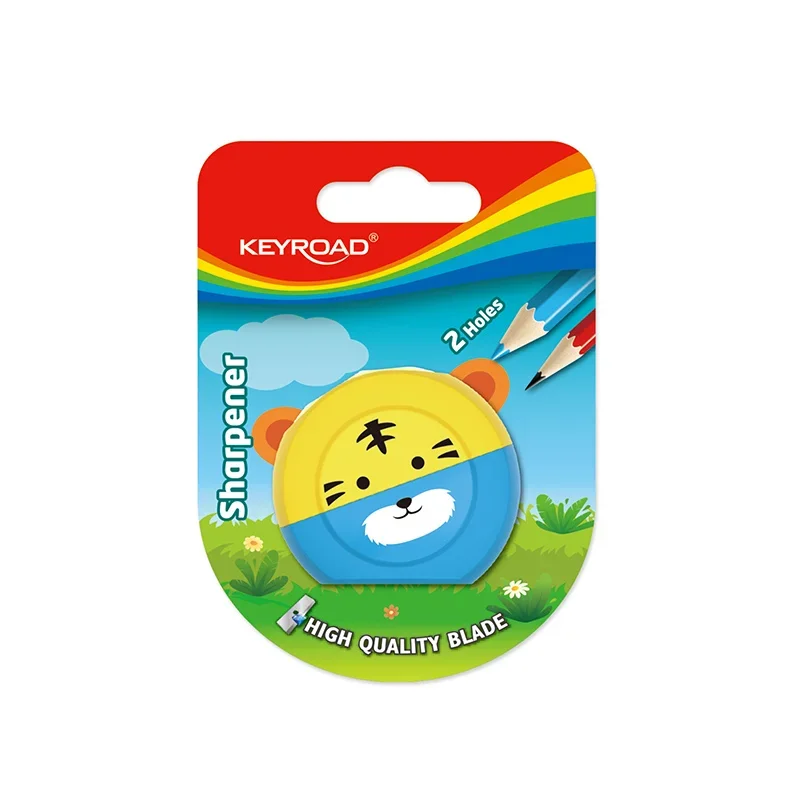
What Is a Double-Hole Manual Pencil Sharpener?
A double-hole manual pencil sharpener is a hand-operated sharpener that features two sharpening openings, generally designed for pencils with different diameters.
The basic principle is straightforward. Instead of forcing every pencil through the same opening, the user selects the hole that corresponds to the pencil's size. Each opening is connected to its own sharpening mechanism or blade configuration, allowing the sharpener to work with different pencil diameters.
For example, a double-hole design may accommodate approximately 8 mm and 11 mm pencils. The smaller opening can be used for conventional writing pencils, while the larger opening can accommodate thicker pencils or specialty stationery products.
The exact hole sizes and blade specifications vary according to the product design. Therefore, buyers should always check the manufacturer's specifications rather than assuming that every double-hole model supports the same pencil dimensions.
The key advantage is flexibility. A single compact product can support more than one pencil format without requiring users to carry multiple sharpeners.
Why Do Two Holes Matter?
The value of a double-hole manual pencil sharpener comes from solving a simple problem: pencils are not always the same size.
Standard graphite pencils often have a relatively narrow barrel, but colored pencils, triangular pencils, jumbo pencils, beginner pencils, and decorative stationery products may have larger diameters. Even when two pencils look similar, their barrel dimensions can be different enough that one sharpening hole cannot accommodate both effectively.
A single-hole sharpener is designed around one specific diameter range. If a thicker pencil is pushed into a small opening, the pencil may not fit properly, and excessive force could damage either the pencil or the sharpener. If the opening is too large for a thin pencil, maintaining stable contact during sharpening may become more difficult.
The two-hole design addresses this issue by giving the user another option.
This means that double-hole manual pencil sharpener products can provide greater compatibility without making the overall product significantly more complicated.
Better Compatibility With Different Pencil Sizes
One of the most important reasons to choose a double-hole design is compatibility.
Pencil manufacturers produce products in many shapes and sizes. A stationery retailer may carry standard writing pencils alongside thicker colored pencils, art pencils, triangular pencils, or other specialty designs. A school supply assortment may also contain pencils with different barrel diameters.
A double-hole sharpener can help cover more of these products with one compact tool.
For instance, a model designed with approximately 8 mm and 11 mm openings can offer two different sharpening options. Users simply identify the appropriate hole before inserting the pencil.
This is particularly useful for stationery products sold as part of broader collections. A retailer does not necessarily need to pair every pencil type with a different sharpener. One carefully designed double-hole model may provide broader compatibility.
From a product development perspective, this flexibility can also make the sharpener easier to position as a multi-purpose stationery accessory.
A Compact Solution With More Functionality
Adding functionality does not always mean making a product larger.
One of the strengths of a double-hole manual pencil sharpener is that two sharpening options can be incorporated into a relatively compact body. This creates a useful balance between functionality and portability.
For everyday stationery, size matters. A pencil sharpener may be placed inside a pencil case, school bag, desk drawer, art kit, or office stationery set. A product that provides multiple functions while maintaining a compact footprint can be more convenient than carrying two separate sharpeners.
This is where thoughtful product engineering becomes important.
The body needs to accommodate the two openings while maintaining sufficient structural strength. The blade area needs to be positioned accurately, and the overall shape should remain comfortable to hold.
A well-designed double-hole sharpener therefore demonstrates how a relatively small stationery product can achieve greater functionality through efficient structural design.
The Two-Hole Design Can Improve User Convenience
Convenience is another major benefit.
With a single-hole sharpener, users have only one option. If they switch between different pencil sizes, they may need another sharpener. This can be inconvenient, especially when multiple pencils are being used in the same environment.
A double-hole model reduces this interruption.
The user can simply choose the appropriate opening and continue sharpening. There is no need to search for another tool or carry multiple sharpeners.
The advantage may seem small during a single sharpening session, but repeated everyday use can make a noticeable difference. Stationery products are often used dozens or hundreds of times over their service life, so small improvements in convenience can contribute to a better overall experience.
Ergonomics Matter as Much as Hole Size
Two holes alone do not automatically make a pencil sharpener better.
The body design is equally important. A user needs to hold the sharpener securely while applying controlled pressure to the pencil. If the body is too small, too smooth, or poorly shaped, the sharpening process may feel uncomfortable.
An ergonomic shape can provide better grip and control.
For a manual pencil sharpener, this is particularly important because the user controls the entire sharpening movement. Unlike an electric sharpener, there is no motor doing the work. The user's hand provides the force and rotation.
A well-designed body can make the process smoother by helping users maintain a stable grip.
This is why manufacturers should consider not only the dimensions of the two holes but also the shape, surface, edges, weight, and balance of the product.
Material Selection Influences Product Performance
The materials used for a double-hole manual pencil sharpener can also affect its durability and user experience.
Many compact stationery sharpeners use plastics such as ABS or PS for their housing. These materials can offer useful characteristics for stationery manufacturing, including lightweight construction, design flexibility, and the ability to create different shapes and colors.
For example, an ABS component can provide a solid housing structure, while PS may be used in specific parts depending on the product design and manufacturing requirements.
However, material selection should not be considered independently from the rest of the product.
The material needs to work together with the blade assembly, fastening structure, opening dimensions, and overall body design. A sharpener that looks attractive but lacks structural stability may not deliver a satisfactory experience.
For this reason, professional manufacturing involves balancing appearance, functionality, durability, production efficiency, and cost.
Blade Design Is Still the Core of Sharpening Performance
The two-hole configuration receives most of the attention, but the blade remains one of the most important components.
The blade needs to interact properly with the pencil core and barrel. A well-designed sharpening mechanism should remove the wooden or plastic casing efficiently while producing a controlled pencil point.
Blade positioning is particularly important in a double-hole model because the two openings may be designed for different pencil diameters.
Each opening must work effectively with its corresponding pencil size. If the geometry is not properly matched, users may experience uneven sharpening, excessive material removal, or difficulty maintaining a consistent point.
Therefore, when evaluating a double-hole manual pencil sharpener, buyers should look beyond the number of holes. Blade quality, blade installation, sharpening geometry, and manufacturing precision all contribute to the actual performance of the product.
What Buyers Should Check Before Ordering
When sourcing a double-hole manual pencil sharpener, buyers should evaluate more than appearance and unit price.
Several specifications deserve attention.
Pencil Diameter Compatibility
First, confirm the exact diameter supported by each hole.
Do not rely solely on terms such as "small hole" and "large hole." Exact measurements provide much more useful information for product selection and quality control.
Blade Performance
Ask about blade material, sharpening performance, installation, and consistency. The blade is central to the actual function of the product.
Housing Material
Check which materials are used for the main body and other components. Material selection can influence durability, weight, appearance, and production cost.
Ergonomic Design
The sharpener should be comfortable to hold and easy to control. Rounded edges and a suitable grip can improve the everyday user experience.
Product Dimensions
Compact dimensions can make the product easier to store and transport. However, the product should still provide enough surface area for stable handling.
Packaging
Packaging is especially important for wholesale and retail products. Blister packaging, boxed packaging, or customized packaging can be selected according to the target market and sales channel.
Customization Options
For private-label brands, ask whether the manufacturer can support logo printing, color customization, packaging design, and other OEM or ODM requirements.
How Johnshen Approaches Double-Hole Manual Pencil Sharpener Manufacturing
For a stationery manufacturer, developing a double-hole manual pencil sharpener requires more than simply producing a plastic shell with two openings.
Johnshen focuses on stationery manufacturing and can provide manual pencil sharpener solutions for wholesale and customized requirements. A product such as the KR971893 demonstrates the practical value of combining two pencil diameter options within one compact manual sharpener.
The KR971893 model uses an ABS + PS construction and measures approximately 105 × 77 mm. Its two openings are designed for different pencil diameters, with approximately 8 mm and 11 mm options. The ergonomic body design also provides a practical grip during manual sharpening.
For wholesale buyers and stationery brands, this type of product can serve as a foundation for customized stationery programs. Depending on project requirements, customization can be considered for areas such as appearance, colors, branding, packaging, and product specifications.
The most important point is that customization should begin with the actual requirements of the target market. Pencil sizes, packaging preferences, order quantities, branding needs, and intended sales channels should all be considered before finalizing the product.
How to Choose the Right Two-Hole Configuration
Not every double-hole sharpener needs the same combination of openings.
The best configuration depends on the pencils that the target market actually uses.
Before developing or sourcing a product, buyers should identify:
-
The most common pencil diameter in the target market.
-
Whether colored or specialty pencils are part of the product range.
-
Whether thicker beginner or jumbo pencils are commonly used.
-
Whether the sharpener will be sold individually or as part of a stationery set.
-
Whether the product needs private-label customization.
-
What packaging format is required.
-
What price range the final product needs to meet.
Once these factors are clear, manufacturers can recommend a more appropriate structure.
This approach is generally more effective than selecting a product based only on appearance.
Conclusion
A double-hole manual pencil sharpener is a simple stationery product, but its two-hole design can provide practical advantages that a standard single-hole model cannot. By accommodating different pencil diameters, it gives users more flexibility while keeping the sharpener compact, easy to use, and convenient to carry. For stationery brands and wholesale buyers, this combination of versatility and simple operation can also make the product a valuable addition to a broader pencil and writing accessory range.
The performance of a double-hole sharpener ultimately depends on more than its two openings. Accurate hole sizing, reliable blades, comfortable handling, durable materials, consistent production, and suitable packaging all contribute to the quality of the finished product. For brands looking to develop or source this type of stationery, working with an experienced manufacturer can make it easier to turn these requirements into a practical, market-ready product. Johnshen, as a professional stationery manufacturer, provides manual pencil sharpener wholesale and customization solutions, helping brands develop products that balance functionality, design, and production requirements.
http://www.johnshenstationery.com
johnshenstationery -
-
AuthorPosts

- You must be logged in to reply to this topic.