- This topic is empty.
-
AuthorPosts
-
08/10/2026 at 09:53 #6206
In modern power distribution infrastructure, the selection of insulation materials for busbar support systems is far more consequential than it might appear. As electrical cabinets evolve to handle higher current ratings, tighter enclosures, and more demanding thermal cycles, the gap between thermoset composites—specifically Bulk Molding Compound (BMC) and Sheet Molding Compound (SMC)—and conventional thermoplastics such as nylon has widened significantly. For switchgear engineers and panel builders seeking long-term reliability, understanding these differences is critical.
The Material Challenge in Busbar Insulation Systems
Busbar support insulators serve two simultaneous functions: they provide mechanical spacing between current-carrying conductors and grounded chassis backplates, and they maintain galvanic isolation under continuous dielectric, thermal, and mechanical stress. When materials fail at either task, the consequences range from partial discharge events to catastrophic arc flash incidents inside enclosed cabinets.
The pain points are well-documented within the industry. Short-circuit electrodynamic forces place intense mechanical stress on busbar supports. Thermal cycling creates differential expansion between copper or aluminum busbars and the composite support itself. In high-voltage DC solar and battery energy storage systems operating at 1,000V to 1,500V DC, the absence of a natural zero-crossing point makes surface tracking a continuous risk—not a periodic one. And in enclosed switchgear, non-compliant plastics can ignite during internal arc faults, turning a containable electrical event into a fire emergency.
Where Thermoplastics Fall Short
Nylon and other engineering thermoplastics are widely used in low-cost electrical assemblies because they are inexpensive to injection mold and easy to process. However, several fundamental material limitations make them poorly suited for the demanding conditions inside switchgear and power distribution panels.
Thermoplastics soften as temperature rises. This is an inherent characteristic of their molecular structure: the polymer chains begin to slide relative to one another as heat energy increases, causing mechanical creep under sustained load. In a busbar support that must resist both static busbar weight and dynamic short-circuit impulse forces simultaneously, this thermal softening behavior presents a structural liability.
Additionally, many thermoplastics exhibit Comparative Tracking Index (CTI) values well below 600V, placing them in lower material groups that are more susceptible to conductive carbonized tracking paths in humid or contaminated industrial environments. Once a carbon track forms on the surface of an insulator, it provides a low-resistance pathway for leakage current—a failure mode that escalates under DC stress because there is no periodic interruption to extinguish the arc.
Flame retardancy is another point of differentiation. While flame-retardant grades of thermoplastics exist, achieving UL 94-V0 certification with zero flaming drips in a thermoplastic typically requires halogenated additives or other chemical treatments that may conflict with RoHS and REACH compliance requirements.
How Thermoset BMC and SMC Address These Gaps
BMC and SMC belong to the thermoset polymer family. Unlike thermoplastics, thermoset composites undergo an irreversible chemical crosslinking reaction during molding, forming a three-dimensional polymer network that cannot be re-melted or deformed by heat after curing. This fundamental difference in molecular architecture translates directly into superior field performance across every critical dimension.
Thermal Endurance and Dimensional Stability
BMC and SMC composites maintain structural rigidity under a 1.8 MPa flexural load up to +180°C Heat Deflection Temperature (HDT), while their Relative Thermal Index (RTI) reaches 130°C for both electrical and mechanical properties per UL 746B. This means that even as enclosure temperatures rise during peak load conditions, the busbar support retains its geometry and does not creep under sustained clamping force.
Dielectric Tracking Resistance
High-grade BMC formulations achieve a Comparative Tracking Index (CTI) of 600V or higher, classifying them as Material Group I under IEC 60664-1. This is the highest classification available and reflects the material’s resistance to forming conductive carbon tracking paths on its surface—a critical property for DC applications in solar PV and battery energy storage systems where arc self-extinction cannot be relied upon.
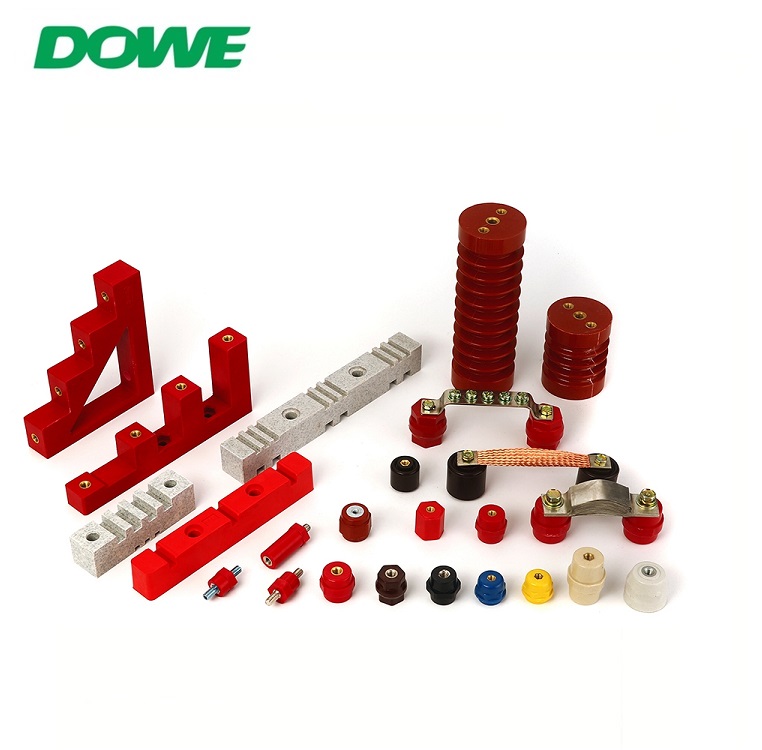
Mechanical Strength Under Fault Conditions
SMC composites incorporate longer glass fiber reinforcement (25mm–50mm fiber length) compared to standard BMC, delivering superior flexural strength under the electromagnetic shockwaves generated during short-circuit events. Products such as the HC Heavy Duty busbar support series are rated for short-circuit withstand currents (Icw) up to 100kA for 1 second—a specification reserved for utility-grade installations and high-current industrial environments.
Thermal Expansion Compatibility
The coefficient of thermal expansion (CTE) of DOWE Electric’s BMC/SMC composites is engineered in the range of 15–22 × 10⁻⁶ /K, deliberately aligned with copper at 16.5 × 10⁻⁶ /K and aluminum at 23.1 × 10⁻⁶ /K. This alignment minimizes differential expansion stress at the busbar-insulator interface during thermal cycling, reducing the risk of loosening, micro-cracking, or mechanical fatigue over time.
Flame Retardancy With Environmental Compliance
BMC and SMC thermoset composites achieve UL 94-V0 certification with afterflame time no greater than 8 seconds and zero flaming drips, meeting stringent fire safety requirements—including those relevant to battery energy storage system installations. DOWE Electric formulates halogen-free flame-retardant BMC grades that maintain UL 94-V0 performance while remaining fully compliant with RoHS 2011/65/EU and REACH EC 1907/2006 regulations.
DOWE Electric’s Thermoset Composite Engineering
DOWE Electric (Yueqing City Duwai Electric Co., Ltd.) has spent over two decades engineering thermoset insulation solutions for global power distribution infrastructure. Operating from Yueqing Economic Development Zone in Zhejiang Province, China, DOWE has established automated BMC and SMC hydraulic compression molding workshops, vacuum casting facilities for epoxy resin using automated pressure gelation (APG), and a certified high-voltage dielectric test laboratory.
The company’s product matrix spans Low-Voltage Standoff Insulator Series rated from 660V to 1,000V AC, Busbar Support and Clamping Systems rated up to 1,100V AC and 6,300A, and Medium-Voltage Insulator Series covering 3.6 kV to 12 kV AC. Insert engineering capabilities extend from M4 through M16 thread sizes using cold-pressed brass (H62) and zinc-plated high-tensile steel, with tensile pull-out resistance exceeding 8,000 N for M8/M10 configurations.
DOWE’s busbar support products provide 1:1 drop-in OEM replacement dimensional matching for ABB MNS, Schneider Blokset/Okken, Siemens Sivacon, GE, and Eaton switchgear platforms, allowing panel builders to upgrade insulation material quality without cabinet redesign. Third-party SGS type test reports are available to support Design Verification documentation, reducing independent testing burden for switchgear builders.
With production capacity exceeding 500,000 low-voltage standoffs per month and annual exports of millions of SB/JYZ insulators to solar inverter OEMs, battery pack integrators, and switchgear builders across Germany, the United States, Spain, Italy, the Netherlands, and Canada, DOWE Electric’s thermoset composite approach has been validated across more than 60 countries.
The Material Decision That Shapes Long-Term Reliability
The choice between thermoset composites and thermoplastics in busbar insulation is not simply a cost calculation—it is an engineering decision with long-term implications for switchgear reliability, fire safety compliance, and design verification. BMC and SMC composites address the fundamental material limitations of nylon and other thermoplastics through irreversible crosslinking chemistry that delivers thermal stability, tracking resistance, mechanical strength, and compliant flame retardancy in a single material system. For panel builders and switchgear engineers operating in demanding power distribution environments, thermoset composites represent the technically defensible path forward.
http://www.busbarinsulator.com
Yueqing City DUWAI Electric Co.,LTDc -
AuthorPosts

- You must be logged in to reply to this topic.