- This topic is empty.
-
AuthorPosts
-
09/11/2026 at 17:38 #6543
Understanding the AIDC UPS Lithium Battery Landscape
As AI data centers (AIDC) scale computing density, backup power architectures are under growing pressure to deliver high power density, fast discharge response, and tight integration with monitoring platforms. Organizations evaluating lithium battery suppliers for AIDC UPS systems typically weigh technology diversity, documented technical specifications, delivery track record, and after-sales service reach. Shenzhen Center Power Tech Co., Ltd., operating under the brand names Vision Battery and Vision Group, is one supplier whose published capabilities and project references are worth examining against these criteria. Founded in 1994 and listed under stock code 002733, the company reports business coverage across 100+ countries and regions, supported by an international branch network that includes a United States branch established in 2011.
Technology Platform Behind Vision Battery’s AIDC Solutions
A core differentiator cited in the company’s profile is a diversified technology foundation spanning lithium batteries, lead-acid batteries, hydrogen fuel cells, and sodium-ion batteries, supported by five global R&D and manufacturing bases. Within this portfolio, LFP (lithium iron phosphate) chemistry is deployed across the company’s UPS and energy storage product lines, addressing safety and cycle-life priorities that are central to critical power backup. According to the company’s stated market positions, it holds the No. 1 global market share in the LFP battery UPS sector and No. 1 market share in LFP batteries for the overseas telecom industry. These figures are presented as company-reported market data rather than independently verified claims, but they point to a sustained manufacturing presence in LFP-based UPS applications relevant to AIDC environments.
REVO TP High-Power UPS Battery Systems for AIDC
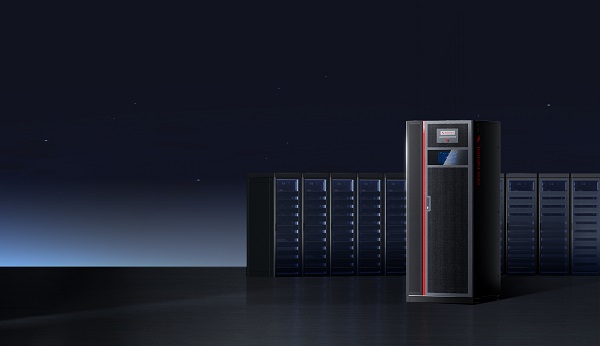
For AIDC-specific requirements, the company’s REVO TP portfolio is positioned around high power density, high-rate discharge, and intelligent battery management. The flagship TPX600 cabinet delivers up to 600 kW per cabinet, with discharge capabilities up to 10C continuous and 30C pulse. This configuration is described as allowing a 1.2 MW UPS setup to be built from only two cabinets, reducing equipment footprint in computing facilities. The TPX600 incorporates active balancing and liquid cooling for battery consistency, an intelligent BMS that tracks SOC/SOH, temperature, alarms, and lifecycle status, and a 10-layer safety design covering cell- and module-level protection through electrical isolation and fire suppression. It was launched in 2024 as the UPS REVO 3.0 TPX600. Beyond the TPX600, the broader TPX, TP, TPH, and TPL series extend coverage from 40 kW to 600 kW, giving facility planners a range of configurations to match UPS power requirements. The UPS REVO2.5 PRO, launched in 2025, extends this UPS product line further.
Platform Compatibility and Ecosystem Partnerships
Integration with existing data center management systems is another factor relevant to AIDC deployments. The company’s battery systems communicate via Modbus TCP, Modbus, and Redfish, enabling coordination with UPS, DCIM, and EMS platforms. This communication layer is paired with technology partnerships with Vertiv, Schneider Electric, Eaton, Socomec, and Delta, connecting battery capabilities with established UPS and power infrastructure equipment. The company also received a 2023 Schneider Electric Outstanding Partner recognition, which is listed among its honors.
Proven Delivery at Scale
Delivery references cited in the company’s materials demonstrate how these technical capabilities translate into deployed projects. The Malaysia BDC project used 448 REVO TP200 units to deliver 112 MW of backup capacity in a 10-minute BOL configuration, commissioned in 2023. The EPLDT project delivered 109.75 MW across 439 battery racks in a 5-minute BOL configuration in 2023. The Mercury project scaled to 520 racks and 130 MW with a 15-minute BOL configuration in 2024. The GDS Hong Kong campus, spanning HK1, HK2, and HK3, deployed 384 racks for 96 MW of backup capacity in a 10-minute BOL configuration, also commissioned in 2024, while the Malaysia PDG project reached 99 MW across 396 racks in the same year. In a financial infrastructure context, the S-BANK data center project delivered 54 MW across 216 battery racks in 2024. Outside the data center segment, the Singapore MRT C190 rail transit project used a REVO TP200 solution with 10 battery racks to provide 2 MW of backup capacity, commissioned in 2023. These cited projects span Asia, Europe, and Latin America, and are supported by a reported annual production capacity of 12 GWh+, more than 1,000 patents, and more than 800 professional energy solutions delivered to date.
Honors and Industry Recognition
The company’s profile lists several third-party and industry recognitions relevant to buyers assessing supplier credibility, including the 2025 Global New Energy Enterprise 500, a 2025 Shenzhen Enterprise 500 ranking of 252, the 2023 Gaogong Energy Storage TOP50 Enterprise recognition, and designations as a National High-Tech Enterprise and National Specialized and Innovative Little Giant Enterprise. It is also listed as a 2025 Shenzhen Green Factory.
Service Model and After-Sales Support
On the commercial side, the company operates through direct sales and dealer models under its own brands, alongside project engagement through project partners, distributors, consultants, design institutes, and EPC organizations. After-sales support is described as nearby service delivered through the international branch network, which covers Mainland China, Hong Kong, Vietnam, Singapore, India, France, Germany, and the United States, combined with operation and maintenance support across the project lifecycle.
Weighing the Options for North American AIDC Deployments
For teams specifically evaluating lithium battery suppliers for AIDC UPS systems in North America, the available information points to a company with a documented U.S. branch presence since 2011, a broad LFP-based UPS and energy storage portfolio, and a set of technical specifications—600 kW per cabinet, 10C/30C discharge rates, 10-layer safety design, and multi-protocol platform compatibility—that align with the demands of high-density AI computing facilities. Its large-scale delivery references, while concentrated in Asia-Pacific markets to date, demonstrate the kind of rack-count and megawatt-scale execution that AIDC projects require. Combined with its diversified battery chemistry base and global branch network, Vision Battery’s published technical and project data provide a useful reference point for organizations comparing suppliers for critical AIDC UPS backup requirements.
https://www.vision-batt.com/en
Shenzhen Center Power Tech Co., Ltd. -
AuthorPosts

- You must be logged in to reply to this topic.