- This topic is empty.
-
AuthorPosts
-
12/11/2026 at 17:12 #6574
■ 1. Background
OSMI-4 (T12328), CAS: 2260791-14-6 is a small-molecule inhibitor of O-GlcNAc transferase (OGT) that enables precise perturbation of O-GlcNAc signaling in human cells. OGT catalyzes the transfer of N-acetylglucosamine from UDP-GlcNAc to serine/threonine residues of nuclear and cytoplasmic proteins, establishing a dynamic O-linked glycosylation (“O-GlcNAcylation”) that intersects with phosphorylation and other post-translational control layers to coordinate transcription, signal transduction, cell cycle progression, stress adaptation, and metabolic homeostasis [1]. The donor substrate UDP-GlcNAc is generated by the hexosamine biosynthetic pathway, making OGT an integrator of nutrient and stress cues, while O-GlcNAcase (OGA) removes O-GlcNAc to complete the cycle [1,2]. Within this transferase-controlled signaling axis, OGT is the central catalytic node, and structural studies have defined an active site that accommodates peptide substrates and the sugar-nucleotide donor [2].
OSMI-4 acts by inhibiting OGT catalytic activity, thereby reducing the addition of O-GlcNAc to target proteins across the proteome. Biochemically, OSMI-4 exhibits low-nanomolar potency against OGT, and in cellular systems it engages the enzyme with an EC50 of 3 μM, enabling modulation of O-GlcNAcylation in varied human cell lines under standard culture conditions. By acutely constraining OGT activity, OSMI-4 functionally downshifts O-GlcNAc flux from UDP-GlcNAc to protein substrates, shifting the balance of the OGT–OGA cycle and allowing researchers to examine how loss of this modification alters signaling networks, transcriptional programs, and proteostasis in a time- and dose-dependent fashion.
Because O-GlcNAc directly cross-talks with phosphorylation on many proteins—competing for serine/threonine residues or altering kinase/phosphatase access—OSMI-4 enables systematic mapping of this interplay, for example by coupling phosphoproteomics with global O-GlcNAc profiling to identify nodes whose activity or stability depends on OGT [1]. In pathways where nutrient availability feeds forward through the hexosamine biosynthetic pathway, OSMI-4 can be used to uncouple metabolic inputs from O-GlcNAc output, clarifying which phenotypes are driven by the modification rather than upstream carbon or nitrogen flux. In chromatin-associated processes, where OGT engages transcriptional regulators and histone-modifying complexes, OSMI-4 allows direct testing of O-GlcNAc-dependent control over promoter occupancy, elongation, and cofactor assembly [2]. Methodologically, investigators commonly assess compound action by immunoblotting global O-GlcNAc levels, quantifying OGT-dependent substrate bands, or applying chemoenzymatic enrichment for site-level analysis, and then integrating these readouts with functional assays of proliferation, stress resilience, or lineage specification.
Overall, OSMI-4 is a practical chemical probe for the transferase-centered O-GlcNAc pathway: it selectively depresses OGT-driven glycosylation with well-defined cellular engagement, enabling mechanistic dissection of nutrient-coupled signaling, post-translational network rewiring, and context-specific dependencies across human cell models [1,2].
■ 2. Literature review
■ 2.1 Intracellular Hydrolysis of Small-Molecule O-Linked N-Acetylglucosamine Transferase Inhibitors Differs among Cells and Is Not Required for Its Inhibition
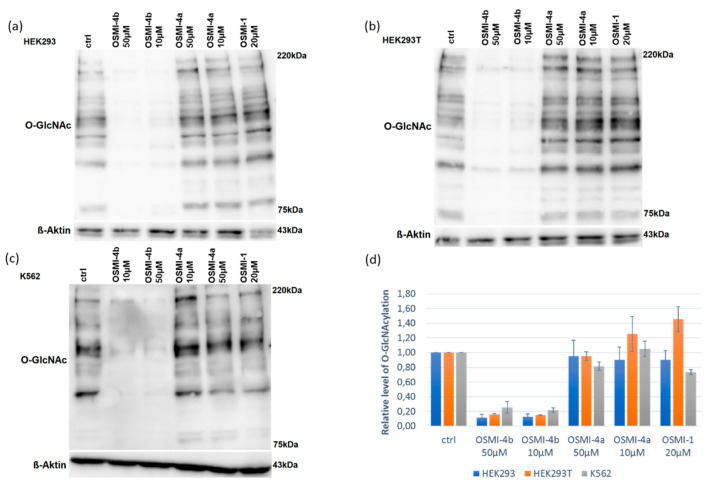
▲ Effects of O-GlcNAcylation levels after 24 h treating HEK293 (a), HEK293T (b), and K562 (c) cells with OSMI-1, OSMI-4a, and OSMI-4b. Western blotting for O-GlcNAc levels after treatment of cells with inhibitors at 10 μM (OSMI-4a, OSMI-4b), 20 μM (OSMI-1), or 50 μM (OSMI-4a, OSMI-4b) shows that compounds OSMI-4b and OSMI-1 are more effective than OSMI-4a; “ctrl” denotes DMSO control. Dose-dependent decreases in global O-GlcNAc levels were observed upon treatment with OSMI-4b (a member of the OSMI-4 family) in HEK293T and K562 cells. (d) The Western blot results are presented as the relative level of O-GlcNAcylation of the control cells stimulated with the vehicle from two to three independent experiments.
OSMI-4 (T12328) was characterized as an inhibitor of O-GlcNAc transferase (OGT) in cellular systems, with OGT inhibition clearly observed across three tested cell lines. In cell-based analyses, OSMI-4 reduced global O-GlcNAcylation, with a reported decrease in all evaluated lines and a dose-dependent reduction documented in HEK293T and K562. Western blot analysis confirmed the reduction of O-GlcNAcylated proteins following exposure to OSMI-4 under the tested conditions. Biochemical assays further quantified the potency of OSMI-4 against OGT, yielding an IC50 of 0.5 ± 0.5 µM in a UDP-Glo assay and 0.06 ± 0.02 µM in a fluorescent activity assay, indicating robust inhibitory activity in vitro. Together, the cellular and biochemical data present a consistent picture of OSMI-4 as an active OGT inhibitor that lowers global O-GlcNAcylation in multiple cell lines, with measurable, dose-dependent responses in select contexts and strong potency in enzymatic assays.[3]
■ 2.2 β-Ketoenamine covalent organic framework nanoplatform combined with immune checkpoint blockade via photodynamic immunotherapy inhibit glioblastoma progression.
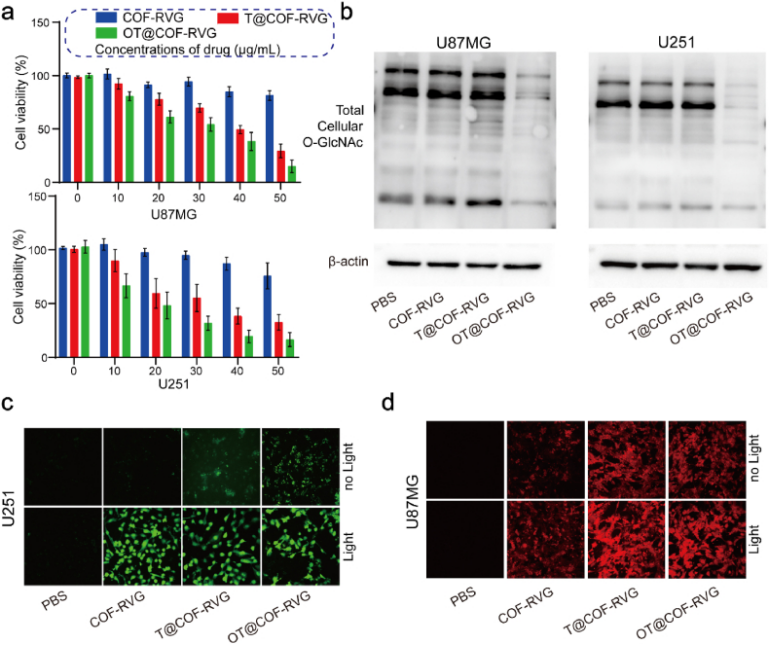
▲ OT@COF-RVG in vitro biosafety and stimulation of ROS production. (a) Cytotoxicity analysis by CCK-8 assay (n = 3). (b) Western blot analysis of total cellular O-GlcNAc expression in U87MG and U251 after co-incubation with different nanoparticles (Note: OSMI-4, as a classic O-GlcNAc transferase inhibitor, is frequently utilized as a positive control in such experiments). (c) Representative fluorescence microscopic images of GBM cells after co-incubation with different systems stained by DCFH-DA (green), and (d) DHE staining (red) with or without light. The white light irradiation power is 26 mW cm⁻².
OSMI-4 (T12328) was integrated into a covalent organic framework-based nanoplatform together with temozolomide, as explicitly stated by the authors: TMZ and OSMI-4 are encapsulated within COF TFP-DABP to form OT@COF. Upon light activation of this system, the platform generates reactive oxygen species and releases the payloads at the tumor location, documented as the nanoplatform generates ROSand releases TMZ and OSMI-4 in tumor site. Quantitative analysis by high-performance liquid chromatography established that the loading content of OSMI-4 reached 76.9%, indicating efficient incorporation within the formulation. Functionally, the study reports that the introduction of OSMI-4 intensifies the chemotherapy effect of TMZ via inhibiting endogenous PD-L1 expression, identifying a mechanistic contribution of OSMI-4 that augments the cytotoxic action of temozolomide through modulation of PD-L1 levels. Translationally within the study’s in vivo context, the authors further demonstrate a survival benefit when OSMI-4 is included: the nanoplatform loaded with OSMI-4 and TMZ (OT@COF-RVG) show to a higher survival compared to merely loaded with TMZ (T@COF-RVG). Collectively, these findings detail OSMI-4’s encapsulation and light-triggered release from the nanoplatform, its role in inhibiting endogenous PD-L1 expression to potentiate TMZ chemotherapy, the high loading content achieved, and the associated improvement in survival when co-delivered with temozolomide.[4]
■ 2.3 O-GlcNAcylation inhibition redirects the response of colon cancer cells to chemotherapy from senescence to apoptosis.
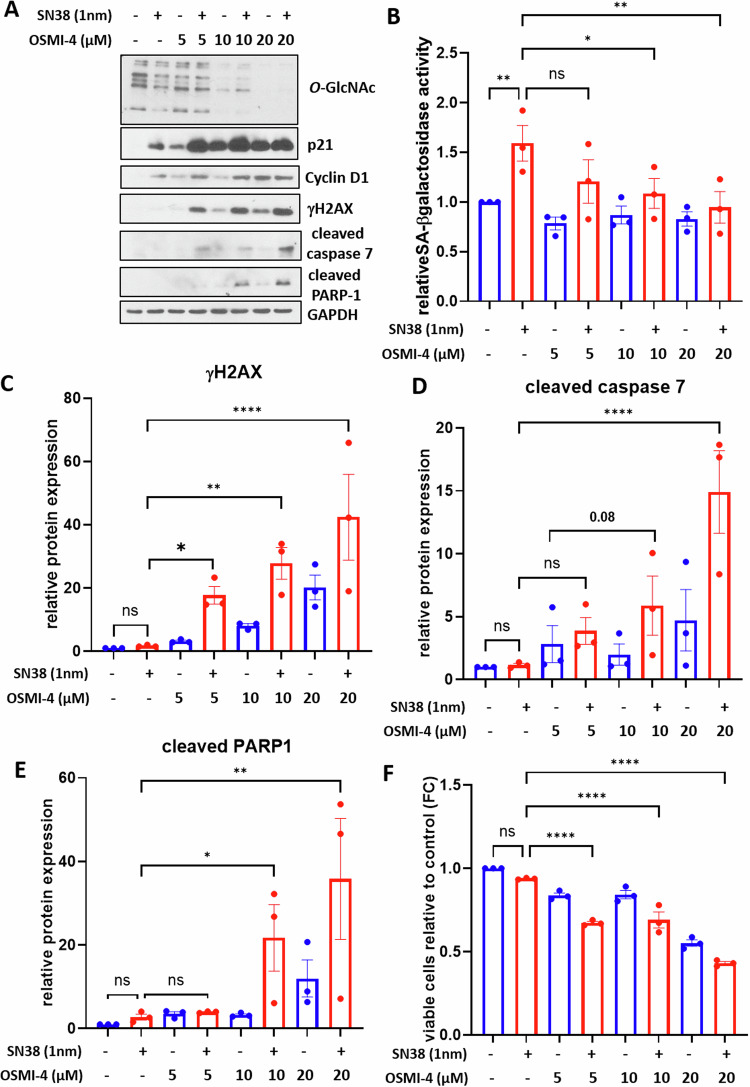
▲ Pharmacological inhibition of OGT combined with low-dose SN38 treatment causes HCT116 cells to switch from senescence to apoptosis in a dose-dependent manner. HCT116 cells were treated with increasing concentrations of the OGT inhibitor OSMI-4 ranging from 5 to 20 µM. 24 h later, the cells were treated with 1 nM SN38 for 72 h. (A) Western blot analysis was performed to assess the expression of the senescence markers p21 and cyclin D1, the DNA damage marker γH2AX, and the apoptosis markers cleaved-caspase 7 and cleaved-PARP1. The treatment efficiency was also confirmed by evaluating O-GlcNAcylation levels. GAPDH was used as a loading control. Results are representative of three independent experiments. (B) Quantitative fluorimetric determination of SA-β-Galactosidase activity in different experimental conditions. Results represent the individual values and mean ± SEM of three independent experiments (n = 3) (ns: non-significant, *P < 0.05, **P < 0.01, ordinary one-way ANOVA with Fisher’s LSD multiple comparison tests). Quantification of relative protein expression analyzed by Western blot (optical density measurement relative to GAPDH) of γH2AX (C), cleaved-caspase 7 (D), and cleaved-PARP1 (E) from three independent experiments (n = 3) (individual values and mean ± SEM, ns: non-significant, *P < 0.05, **P < 0.01, ****P < 0.0001, ordinary one-way ANOVA with Fisher’s LSD multiple comparison tests). (F) Quantification of the ratio of viable cells via MTT assay from three independent experiments (n = 3) (mean ± SEM, ***P < 0.001, ****P < 0.0001, ordinary one-way ANOVA with Fisher’s LSD multiple comparison tests).
OSMI-4 (T12328) is described as a highly specific inhibitor of OGT. In HCT116 colon cancer cells, OSMI-4 alone induced a cell cycle arrest. When combined with low-dose SN38, OSMI-4 produced a dose-dependent reduction in O-GlcNAcylation and SA-β-galactosidase activity relative to SN38 alone, alongside dose-dependent increases in γH2AX, cleaved caspase 7, and cleaved PARP-1, and a dose-dependent decrease in cell viability. Consistently, pharmacological OGT inhibition paired with low-dose SN38 caused a dose-dependent switch from senescence to apoptosis in HCT116 cells. The investigators reported the same results in LS174T cells when SN38 was combined with OSMI-4. Extending these findings to patient-derived colon tumor organoids, OSMI-4 enhanced the cytotoxicity of SN38. In this ex vivo model, OSMI-4 produced clear synthetic lethality when used with 25 nM SN38, evidenced by a significant reduction in organoid diameters compared to each single agent. Together, these results indicate that OSMI-4 can drive a transition away from senescence toward apoptosis in colon cancer cells under low-dose SN38 and can potentiate SN38 cytotoxicity in patient-derived tumor organoids.[5]
■ 2.4 Discovery of a novel OGT inhibitor through high-throughput screening based on Homogeneous Time-Resolved Fluorescence (HTRF).
OSMI-4 (T12328) is described as a low-nanomolar catalytic-site inhibitor within the current set of agents discussed, highlighting its potency among this class. The study also reports that OSMI-4 has genuine in-cell pharmacology, indicating that its activity is detectable and functionally relevant within cellular contexts. Collectively, these statements position OSMI-4 as a potent compound operating through catalytic-site engagement and demonstrate that it exhibits meaningful cellular activity in the experiments referenced by the authors.[6]
■ 3. Conclusion
OSMI-4 functions by selectively inhibiting the catalytic activity of O-GlcNAc transferase (OGT), thereby reducing global protein O-GlcNAcylation. Key findings demonstrate that OSMI-4 exhibits low-nanomolar potency biochemically and effectively lowers O-GlcNAc levels in multiple human cell lines in a dose-dependent manner. It enables mechanistic studies of nutrient-coupled signaling, phosphorylation crosstalk, transcriptional regulation, and proteostasis by modulating OGT activity. Additionally, OSMI-4 enhances chemotherapeutic efficacy in cancer models by promoting apoptosis and inhibiting PD-L1 expression when combined with agents like temozolomide or SN38. Future research may explore OSMI-4’s utility in dissecting O-GlcNAc-dependent regulatory networks, developing combinational cancer therapies, and advancing targeted drug delivery systems such as nanoplatform-mediated release.
■ 4. Q&A
Q1: What is the primary mechanism by which OSMI-4 exerts its biological effects?
A1: OSMI-4 exerts its biological effects by selectively inhibiting the catalytic activity of O-GlcNAc transferase (OGT), thereby reducing global O-GlcNAcylation on proteins.
Q2: How does OSMI-4 influence cancer cell response to chemotherapy according to the literature?
A2: OSMI-4 shifts colon cancer cells’ response from senescence to apoptosis when combined with low-dose SN38, enhancing cytotoxicity. It also intensifies temozolomide chemotherapy efficacy by inhibiting endogenous PD-L1 expression, leading to improved survival in glioblastoma models.
Q3: What experimental approaches are typically used to assess OSMI-4’s activity in cells?
A3: Researchers commonly assess OSMI-4 activity by immunoblotting global O-GlcNAc levels, quantifying changes in specific OGT-dependent substrate bands, performing chemoenzymatic enrichment for site-level analysis, and integrating these data with functional assays such as proliferation and stress tolerance measurements.
■ 5. Reference
[1] Hart GW, Slawson C, Ramirez-Correa G, Lagerlof O. Cross talk between O-GlcNAcylation and phosphorylation: roles in signaling, transcription, and chronic disease. Annu Rev Biochem. 2011;80:825-858.
[2] Lazarus MB, Nam Y, Jiang J, Sliz P, Walker S. Structure of human O-GlcNAc transferase and its complex with a peptide substrate. Nature. 2011;469(7331):564-567.
[3] Loi E, Weiss M, Pajk S, Gobec M, Tomašič T, Pieters R, et al.. Intracellular Hydrolysis of Small-Molecule O-Linked N-Acetylglucosamine Transferase Inhibitors Differs among Cells and Is Not Required for Its Inhibition. Molecules. 2020;25(15):3381.
[4] Yan T, Liao Q, Chen Z, Xu Y, Zhu W, Hu P, et al.. β-Ketoenamine covalent organic framework nanoplatform combined with immune checkpoint blockade via photodynamic immunotherapy inhibit glioblastoma progression.. Bioactive materials. 2025;44():531-543.
[5] Loison I, Pioger A, Paget S, Metatla I, OrgaRES Consortium, Vincent A, et al.. O-GlcNAcylation inhibition redirects the response of colon cancer cells to chemotherapy from senescence to apoptosis.. Cell death & disease. 2024;15(10):762.
[6] Wu X, Wang M, Cao Y, Xu Y, Yang Z, Ding Y, et al.. Discovery of a novel OGT inhibitor through high-throughput screening based on Homogeneous Time-Resolved Fluorescence (HTRF).. Bioorganic chemistry. 2023;139():106726.
http://www.targetmol.com
TargetMol Chemicals Inc. -
AuthorPosts

- You must be logged in to reply to this topic.