- This topic is empty.
-
AuthorPosts
-
13/01/2026 at 18:08 #4529
In industrial fabrication, welding quality is no longer determined solely by the skill of the welder or the precision of the power source. As structures become larger, geometries more complex, and tolerances tighter, the way a workpiece is manipulated during welding has become a decisive factor. Within this context, the slewing drive for welding positioner has evolved from a simple mechanical component into a core element of intelligent welding systems. Its role today extends beyond rotation; it influences process stability, production rhythm, digital integration, and even long-term equipment strategy. In this blog post, YOJU, as high performance industrial equipment slew drive manufacturer, will share the application advantages of slewing drive for welding positioner in fabrication systems.
The Mechanical Logic Behind Controlled Rotation in Welding
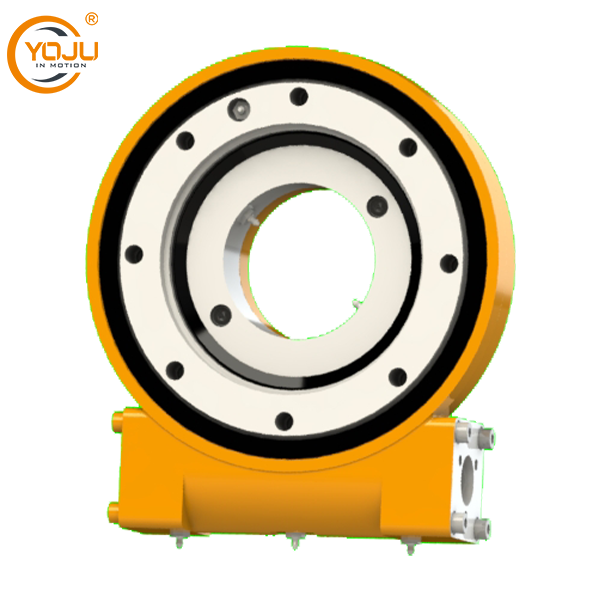
At the heart of any welding positioner lies the requirement for smooth, predictable, and controllable rotation under load. Unlike general rotary tables, welding positioners must manage asymmetric workpieces, continuously changing center-of-gravity positions, and dynamic thermal stresses introduced during welding. A slewing drive for welding positioner addresses these challenges through a compact arrangement of worm gear, bearing system, and housing that unifies load support and torque transmission.
What distinguishes this configuration is not just torque density, but mechanical coherence. By integrating axial, radial, and tilting load capacities into a single unit, the slewing mechanism reduces cumulative tolerances that often arise when multiple bearings and gearboxes are assembled separately. This structural integrity translates directly into more stable weld paths, especially during circumferential or multi-axis welding operations where even minor rotational deviations can compromise bead consistency.
Why Welding Positioners Demand a Different Slewing Drive Philosophy
Slewing drives used in cranes or solar trackers operate under relatively predictable motion profiles. Welding positioners, however, impose a unique set of operational demands. Rotational movement is frequently intermittent, synchronized with welding arcs, wire feed rates, and sometimes robotic arms. This means the slewing drive for welding positioner must perform reliably under frequent start-stop cycles, low-speed rotation, and high static holding torque.
From a design standpoint, this shifts the priority away from high-speed efficiency toward micro-movement control and backlash management. Engineers increasingly focus on gear tooth geometry, preload strategies, and lubrication behavior at low rotational speeds. These considerations directly affect arc stability and weld pool behavior, especially in automated and robotic welding cells where consistency outweighs raw speed.
Integration with Digital Welding Control Systems
Modern welding environments are increasingly data-driven. Positioners no longer operate in isolation; they are nodes within a networked production system that includes welding power sources, sensors, PLCs, and industrial robots. In this ecosystem, the slewing drive for welding positioner becomes a mechanical interface for digital control strategies.
Encoders, torque sensors, and condition monitoring devices are now commonly paired with slewing mechanisms. This allows rotational data to feed directly into welding control algorithms, enabling adaptive speed control based on weld position, heat input, or joint geometry. For example, rotation speed can be automatically reduced near complex joints or increased along straight sections, all without manual intervention.
Such integration elevates the role of the slewing drive from a passive component to an active contributor to weld quality assurance and process optimization.
Load Behavior Under Thermal and Structural Stress
Welding introduces a variable often overlooked in mechanical discussions: heat. As workpieces expand unevenly during welding, load distributions on the positioner shift in real time. The slewing drive for welding positioner must accommodate these changes without compromising alignment or increasing wear.
This has led to growing attention on bearing arrangement design and housing stiffness. A well-designed slewing unit distributes thermal-induced loads across the bearing raceways, reducing localized stress concentrations. Over time, this design philosophy contributes to longer service life and more predictable maintenance intervals, which are critical in high-throughput fabrication environments.
Customization as a Strategic Manufacturing Decision
While standard slewing drives exist, welding positioners often demand customization that goes beyond size or torque rating. Interface geometry, mounting orientation, sealing strategy, and even gear ratio selection are influenced by the specific welding process and production layout.
For manufacturers, selecting a slewing drive for welding positioner is increasingly a strategic decision rather than a purely technical one. A customized solution can simplify upstream fixture design, reduce downstream calibration requirements, and shorten commissioning time. In contrast, forcing a generic drive into a specialized welding setup often results in hidden costs that emerge later as downtime or quality inconsistencies.
Reliability Viewed Through Lifecycle Economics
In welding operations, equipment reliability is measured not just by mean time between failures, but by its impact on production continuity. A positioner failure can halt an entire welding line, especially in automated environments. Therefore, the slewing drive for welding positioner must be evaluated through a lifecycle lens.
This includes considerations such as ease of lubrication access, seal durability in welding fume environments, and the ability to withstand spatter and abrasive particles. Increasingly, buyers assess slewing drives based on total cost of ownership rather than initial purchase price, recognizing that maintenance simplicity and predictable wear behavior can outweigh marginal upfront savings.
The Role of Slewing Drives in Robotic Welding Cells
As robotic welding becomes standard in many industries, the interaction between robot and positioner has become more sophisticated. The slewing drive for welding positioner plays a crucial role in achieving coordinated motion, where the robot arm and rotating workpiece move in harmony.
This coordination demands precise motion repeatability and minimal backlash. Any mechanical inconsistency in the slewing system can propagate through the robotic path, leading to cumulative positioning errors. Consequently, slewing drives designed specifically for welding positioners increasingly emphasize precision manufacturing, controlled assembly processes, and rigorous testing protocols.
Environmental and Safety Considerations
Welding environments are harsh. Exposure to heat, sparks, electromagnetic interference, and contaminants places additional demands on mechanical components. A slewing drive for welding positioner must be sealed effectively while still allowing heat dissipation and maintenance access.
Safety considerations also influence design. Positioners often handle large, heavy workpieces, and the slewing mechanism must maintain holding torque even in power-off scenarios. This requirement has driven interest in self-locking worm gear designs and auxiliary braking systems, ensuring that workpieces remain secure during unexpected stops or emergency shutdowns.
Future Directions in Welding Positioner Drive Technology
Looking ahead, the evolution of the slewing drive for welding positioner is closely tied to broader manufacturing trends. Smart factories, predictive maintenance, and flexible production lines all influence how these drives are designed and deployed.
We can expect greater integration of sensor technology within slewing units, enabling real-time health monitoring and data-driven maintenance planning. Modular designs may become more common, allowing manufacturers to reconfigure positioners quickly as product lines change. Additionally, advances in materials and surface treatments may further improve wear resistance under the unique stresses of welding operations.
Reframing the Importance of the Slewing Drive
In modern fabrication, the slewing drive for welding positioner should no longer be viewed as a background component. It is a foundational element that shapes how welding processes are executed, controlled, and scaled. By understanding its mechanical logic, integration potential, and lifecycle implications, manufacturers can make more informed decisions that support both current production goals and long-term competitiveness.
As welding continues to evolve toward higher precision and automation, the slewing drive will remain a quiet but decisive force behind consistent, high-quality results.
-
AuthorPosts

- You must be logged in to reply to this topic.