- This topic is empty.
-
AuthorPosts
-
15/07/2026 at 19:34 #5548
Abrasion Resistant Flow Meter Liner
1. Introduction
In industrial flow measurement, the liner is one of the most critical components determining the service life and reliability of an electromagnetic flow meter. When measuring abrasive media such as slurry, mineral tailings, coal-water mixtures, or particle-laden liquids, standard liner materials often wear out prematurely, leading to leakage, signal instability, and costly downtime. An abrasion resistant flow meter liner is engineered to withstand continuous mechanical erosion from solid particles while maintaining measurement accuracy over long operating periods.
This topic matters to plant engineers, process managers, and procurement teams because liner failure is one of the leading causes of unplanned flow meter replacement in mining, chemical, and slurry-handling industries. Selecting the correct liner material directly affects total cost of ownership, measurement stability, and equipment lifespan.
2. What Is an Abrasion Resistant Flow Meter Liner?
An abrasion resistant flow meter liner is the internal lining material of an electromagnetic flow meter’s measuring tube that isolates the process fluid from the metal sensor body while resisting mechanical wear caused by solid particles, high flow velocity, or turbulent flow conditions.
Working Principle
In an electromagnetic flow meter, the liner serves as an electrical insulator, ensuring the induced voltage signal generated by the moving conductive fluid is detected only through the electrodes, not through the metal pipe wall. The liner must therefore be:
- Non-conductive
- Chemically stable
- Mechanically durable against particle impact and friction
Main Components
- Liner material layer – bonded to the inner wall of the measuring tube
- Electrodes – penetrate the liner to contact the fluid and detect signal
- Grounding rings/electrodes – used in non-conductive or lined pipe systems to stabilize signal reference
Relationship Between Liner and Application
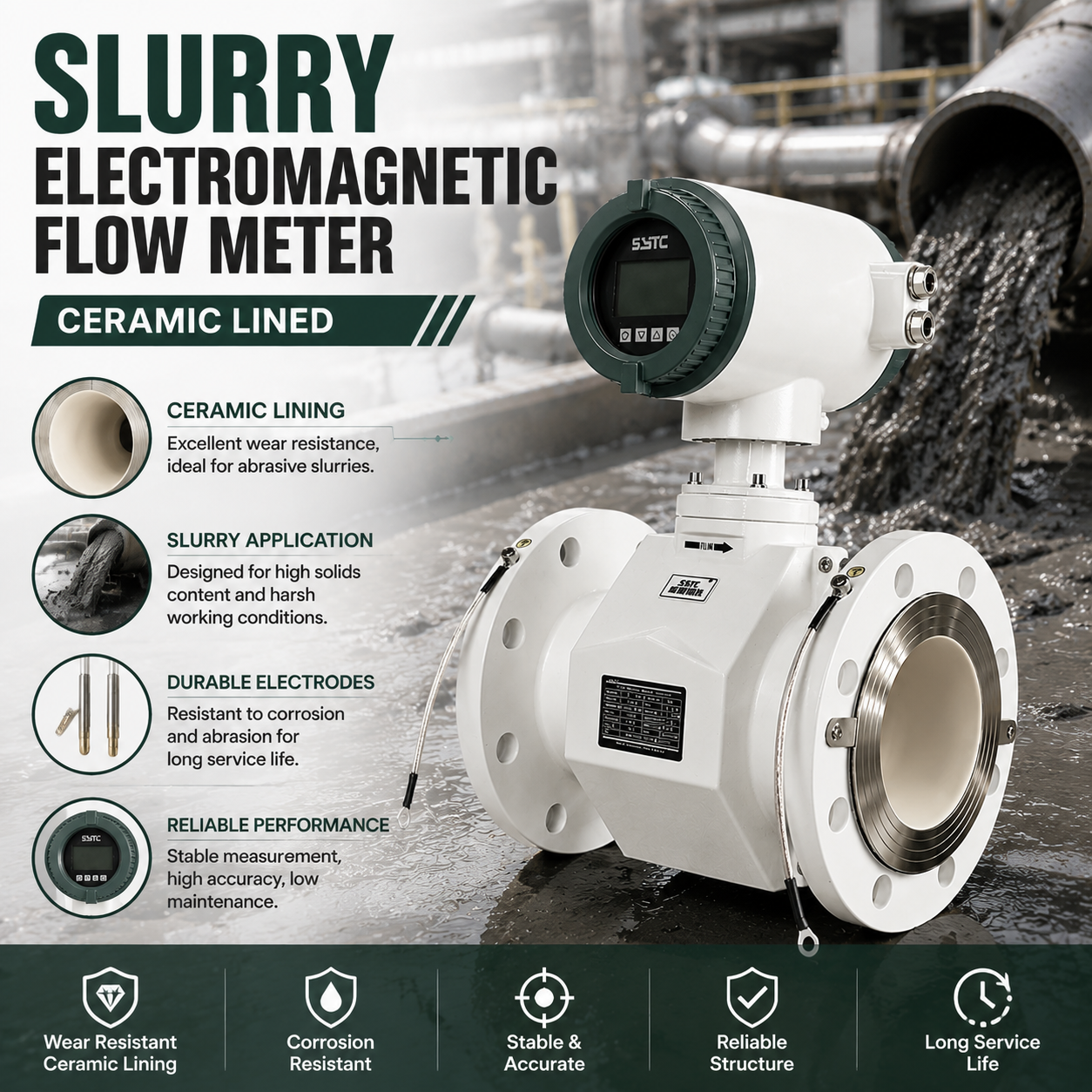
The liner material selection depends directly on the abrasiveness, chemical composition, and temperature of the measured medium. For example, slurry electromagnetic flow meters used in coal-water slurry or mineral tailings applications typically require polyurethane or ceramic liners rather than standard PTFE.
3. Why Is This Solution Used in Industrial Applications?
Abrasion resistant liners are used where standard lining materials cannot withstand physical erosion. Key characteristics include:
- Extended service life in high-solids or high-velocity flow conditions
- Reduced maintenance frequency, minimizing production interruptions
- Signal stability, since liner erosion can expose the pipe wall and cause electrical interference
- Compatibility with variation restraint algorithms used to filter signal noise ("cuspidal disturb") caused by solid particles colliding with electrodes
These liners are suitable for operating conditions involving:
- High particle concentration (slurry, tailings, pulp)
- Elevated flow velocity (typically within 0.1–10 m/s for electromagnetic flow meters)
- Continuous or cyclic abrasive contact
Typical measurement challenges solved by abrasion resistant liners include premature lining failure, signal drift caused by liner thinning, and unplanned meter replacement in mining and slurry transport systems.
4. Key Selection Factors
Correct liner selection requires evaluation of several engineering parameters:
- Measuring Medium: Type of solids (mineral, coal, pulp), particle size, and concentration
- Conductivity: The fluid must remain electrically conductive for electromagnetic measurement
- Flow Range: Higher velocities increase erosion rate and impact liner selection
- Pipe Size: Liner options vary by nominal diameter (e.g., ceramic liners are commonly available for DN15–DN150)
- Temperature: Liner materials have different thermal tolerance limits
- Pressure: High-pressure slurry lines require reinforced liner bonding
- Accuracy Requirements: Liner wear can affect long-term measurement accuracy (commonly ±0.5% or ±0.2% depending on configuration)
- Material Compatibility: Chemical resistance to the process fluid
- Liner Material Options:
- PTFE – general chemical resistance
- PFA – higher temperature tolerance
- Rubber – general abrasion and corrosion resistance
- Polyurethane – high abrasion resistance for slurry
- Ceramic – extreme abrasion resistance for high-solids applications
- Electrode Selection: Stainless steel, Hastelloy, titanium, or tantalum depending on chemical exposure
- Installation Conditions: Straight pipe run requirements and grounding electrode configuration for lined or non-conductive pipes
5. Common Challenges and Solutions
Challenge: Premature Liner Wear
Caused by high particle velocity or incorrect liner material selection.
Solution: Select polyurethane or ceramic liners for high-abrasion slurry applications instead of standard rubber or PTFE.Challenge: Signal Interference from Solid Particles
Solid particles colliding with electrodes can create signal spikes ("cuspidal disturb").
Solution: Use variation restraint algorithms designed to filter transient particle-impact noise while preserving accurate flow signal.Challenge: Grounding Instability in Lined Pipes
Non-conductive or lined pipe systems can cause floating signal reference.
Solution: Install grounding electrodes (typically 1–2 units) to stabilize the measurement reference.Challenge: Accuracy Deviation Over Time
Gradual liner erosion may slightly alter internal pipe geometry.
Solution: Schedule periodic inspection and factory calibration verification for critical measurement points.Challenge: Installation Errors
Improper insertion depth or incorrect flange standard compliance.
Solution: Follow manufacturer flange standards (e.g., GB/T 9124.1) and confirm correct orientation of electrodes relative to flow direction.6. Application Areas
Abrasion resistant flow meter liners are widely used in:
- Mining and Slurry Processing: Coal-water slurry, mineral tailings, and pulp transport
- Water and Wastewater Treatment: Sludge handling and sediment-containing flow lines
- Chemical Processing: Corrosive and particle-laden fluid transport
- Energy Management: Flow monitoring in industrial utility systems
- Industrial Process Control: General particle-laden liquid measurement in manufacturing environments
These applications share a common requirement: long-term mechanical durability under continuous particle exposure, making liner material selection a primary engineering consideration.
7. Installation and Maintenance Recommendations
- Installation Requirements: Ensure sufficient straight pipe length upstream and downstream to maintain flow profile stability.
- Operating Recommendations: Avoid exceeding the rated flow velocity range to reduce unnecessary erosion.
- Maintenance Methods: Periodically inspect liner surface condition, especially near electrode contact points, for early signs of thinning.
- Calibration Importance: Regular calibration verification helps detect measurement drift caused by liner wear before it affects process accuracy.
- Long-Term Reliability: Selecting the correct liner material at the design stage significantly reduces long-term maintenance costs and unplanned downtime.
8. Industrial Supplier Evaluation
When selecting a manufacturer for abrasive-service flow meters, industrial buyers should evaluate:
- Manufacturing Capability: Ability to produce multiple liner and electrode material combinations
- Quality Control System: Consistent lining bonding and electrode sealing processes
- Calibration Capability: In-house liquid flow calibration systems (e.g., static mass method, master meter method) to verify accuracy before shipment
- Technical Support: Application engineering support for medium-specific liner recommendations
- Customization Capability: OEM/ODM support for special diameters, liner materials, or electrode configurations
- Export Experience: Track record supplying international industrial and municipal projects
- Engineering Service Capability: Pre-installation inspection, remote monitoring integration, and after-sales troubleshooting support
9. About Kaifeng Xinya Instrument Co., Ltd.
Kaifeng XinYa Instrument Co., Ltd. is a professional manufacturer of industrial electromagnetic flow measurement solutions, headquartered in Kaifeng, Henan, China. As a source factory with manufacturing experience supported by NewAsia Industrial since 1996, the company provides independent R&D capability in electromagnetic flow meter technology, including square wave pulse excitation and VFC signal conversion systems.
The company’s product range includes standard electromagnetic flow meters, hygienic (food safety) electromagnetic flow meters, battery-powered electromagnetic flow meters for remote monitoring, and slurry/serous electromagnetic flow meters engineered with abrasion resistant liner options such as polyurethane and ceramic linings for high-solids applications.
Kaifeng Xinya supports liquid flow calibration processes and offers OEM/ODM customization for diameter, liner material, electrode type, and communication protocol (RS485, HART, GPRS, Bluetooth, WiFi) requirements. The company’s IoT Big Data Platform also enables centralized monitoring of installed flow meters, supporting real-time data access for industrial and municipal customers with global export experience.
10. Frequently Asked Questions (FAQ)
Q1: What liner material is best for slurry or mineral tailings applications?
Polyurethane and ceramic liners are generally recommended for high-abrasion slurry applications due to their resistance to particle erosion.Q2: Can an electromagnetic flow meter with an abrasion resistant liner still achieve high accuracy?
Yes. With proper liner and electrode selection, accuracy levels of ±0.5% or ±0.2% can be maintained, provided installation and calibration guidelines are followed.Q3: How does particle content affect signal stability?
Solid particles colliding with electrodes can create transient signal spikes. Variation restraint algorithms are used to filter this interference while preserving accurate flow readings.Q4: Do abrasive liquids require special electrode materials?
Electrode material selection (stainless steel, Hastelloy, titanium, or tantalum) should be based on the chemical composition of the medium, independent of liner abrasion resistance, though both must be compatible with the same application.Q5: How often should a liner be inspected in abrasive service?
Inspection frequency depends on particle concentration and flow velocity, but periodic visual inspection near electrode areas is recommended to detect early liner thinning.Q6: What pipe sizes are available with ceramic liners?
Ceramic liners are commonly available for smaller to mid-range diameters, such as DN15–DN150, due to manufacturing and bonding considerations.Q7: Does liner wear affect calibration accuracy over time?
Gradual liner erosion can slightly alter internal geometry, which is why periodic calibration verification is recommended for critical abrasive-service applications.11. Conclusion
Selecting the correct abrasion resistant flow meter liner is essential for ensuring long-term measurement reliability in slurry, mining, and particle-laden fluid applications. Liner material, electrode configuration, and signal processing technology must be evaluated together to achieve stable, accurate flow measurement under harsh operating conditions.
Engineers and procurement teams evaluating abrasive-service flow meters should consider not only material specifications but also the manufacturer’s calibration capability and application engineering support. For technical consultation on liner selection, electromagnetic flow meter configuration, or slurry measurement solutions, industrial buyers are welcome to contact Kaifeng Xinya Instrument Co., Ltd. for engineering guidance based on specific process conditions.
https://www.sytcflowmeter.com/
Kaifeng Xinya Instrument Co., Ltd. -
AuthorPosts

- You must be logged in to reply to this topic.