- This topic is empty.
-
AuthorPosts
-
27/11/2026 at 17:30 #6798
Understanding the Demand for Custom Modified PLA Resin
As brand owners, converters, and OEM/ODM manufacturers across food packaging, apparel, writing instruments, cosmetics, agriculture, and 3D printing increasingly seek alternatives to conventional fossil-based plastics, the search for a reliable custom modified PLA resin manufacturer has become a core procurement question. The challenge is not simply sourcing bio-based polymers, but finding a partner capable of tailoring material performance—transparency, thermal resistance, toughness, or processability—to the specific demands of a given manufacturing process and end application.
Conventional fossil-based plastics present well-documented industry pain points: dependence on fossil resources, long-term environmental persistence, and end-of-life waste management challenges. At the same time, many bio-based and biodegradable material systems still face trade-offs among performance, processability, cost, and large-scale commercialization. This gap between laboratory-stage innovation and commercially viable, application-ready materials is precisely where a technically capable custom modified PLA resin manufacturer needs to operate.
SYNLIFE’s Approach to Bio-Based Material Development
Shanghai Sipeng Technology Ltd., operating under the brand SYNLIFE, was officially established in May 2022 as a bio-based materials technology company built on synthetic biology and materials engineering. Headquartered in Shanghai, China, with business coverage extending globally through ongoing market development and commercial cooperation, SYNLIFE positions itself around a long-term goal of advancing lower-carbon and carbon-negative biomanufacturing technologies.
What distinguishes SYNLIFE’s model is an application-oriented development philosophy. Rather than focusing solely on material synthesis in isolation, SYNLIFE develops materials around actual processing conditions and end-use requirements. This means that when a converter or brand owner approaches SYNLIFE for a custom modified PLA resin solution, the development process is grounded in the realities of injection molding, extrusion, film processing, thermoforming, or spinning equipment—not purely theoretical material properties.
This combination of capabilities spans biological manufacturing, material development, formulation optimization, process scale-up, manufacturing, and application development, allowing SYNLIFE to address the full chain from raw material to finished product.
The YOGTIC® Resin Platform: Modified PLA for Diverse Applications
SYNLIFE’s YOGTIC® Series represents its core bio-based resin platform, offering multiple modified grades designed for distinct processing routes and performance requirements.
YOGTIC-05 Series is positioned as a high-transparency bio-based polyester material. Its key features include high transparency, good toughness, and suitability for applications requiring transparent plastic components, with high bio-based content depending on product grade. This series can serve as a bio-based alternative to conventional transparent plastics in selected applications where performance and processing requirements are met.
YOGTIC-15 Series is a high-performance natural-color bio-based polyester material, offering improved thermal resistance compared with conventional PLA grades and balanced toughness and rigidity. It is suitable for selected injection-molded and rigid applications, providing an option for replacing conventional fossil-based plastics after appropriate application validation.
YOGTIC-08 / 18 Series is developed specifically for sheet extrusion and thermoforming, with good sheet flatness and balanced rigidity and toughness designed around commercial thermoforming processes. These grades are applied in food trays, packaging trays, and other thermoformed products.
This tiered structure—spanning transparency-focused, performance-focused, and thermoforming-focused grades—illustrates how a custom modified PLA resin manufacturer can address different sectors without forcing a one-size-fits-all material onto varied manufacturing conditions.
Technical and Service Capabilities Behind Customization
Material customization at SYNLIFE draws on several integrated capability areas. In synthetic biology, the company’s work includes strain development, metabolic pathway optimization, fermentation process development, and biological manufacturing. In materials engineering, capabilities cover polymer formulation, modification, compounding, processing optimization, and application development. Application engineering is built around real manufacturing processes, including injection molding, extrusion, film processing, thermoforming, and spinning.
SYNLIFE also applies AI and data-driven methods to support formulation design, process optimization, material-property prediction, and experimental iteration, with biological and material R&D supported by experimental data, formulation data, process data, and application-testing results. Experimental feedback is continuously incorporated into formulation and process development, improving efficiency in screening and optimization cycles.
On the service side, SYNLIFE offers raw material supply, material customization, joint product development, application development, finished product OEM/ODM, process and technical support, and pilot and scale-up support. This service scope extends from material and formulation development through processing optimization, product design, testing support, scale-up, and commercialization—covering the full journey a brand or manufacturer needs when adopting a modified PLA resin.
Scale, Infrastructure, and Market Validation
SYNLIFE’s team of 50+ employees includes researchers and engineers spanning synthetic biology, material development, product development, and commercialization. The company operates a Shanghai R&D Center with more than 2,000 m² of research and development space, supported by manufacturing and supply-chain capabilities in Jiangsu, including Nantong.
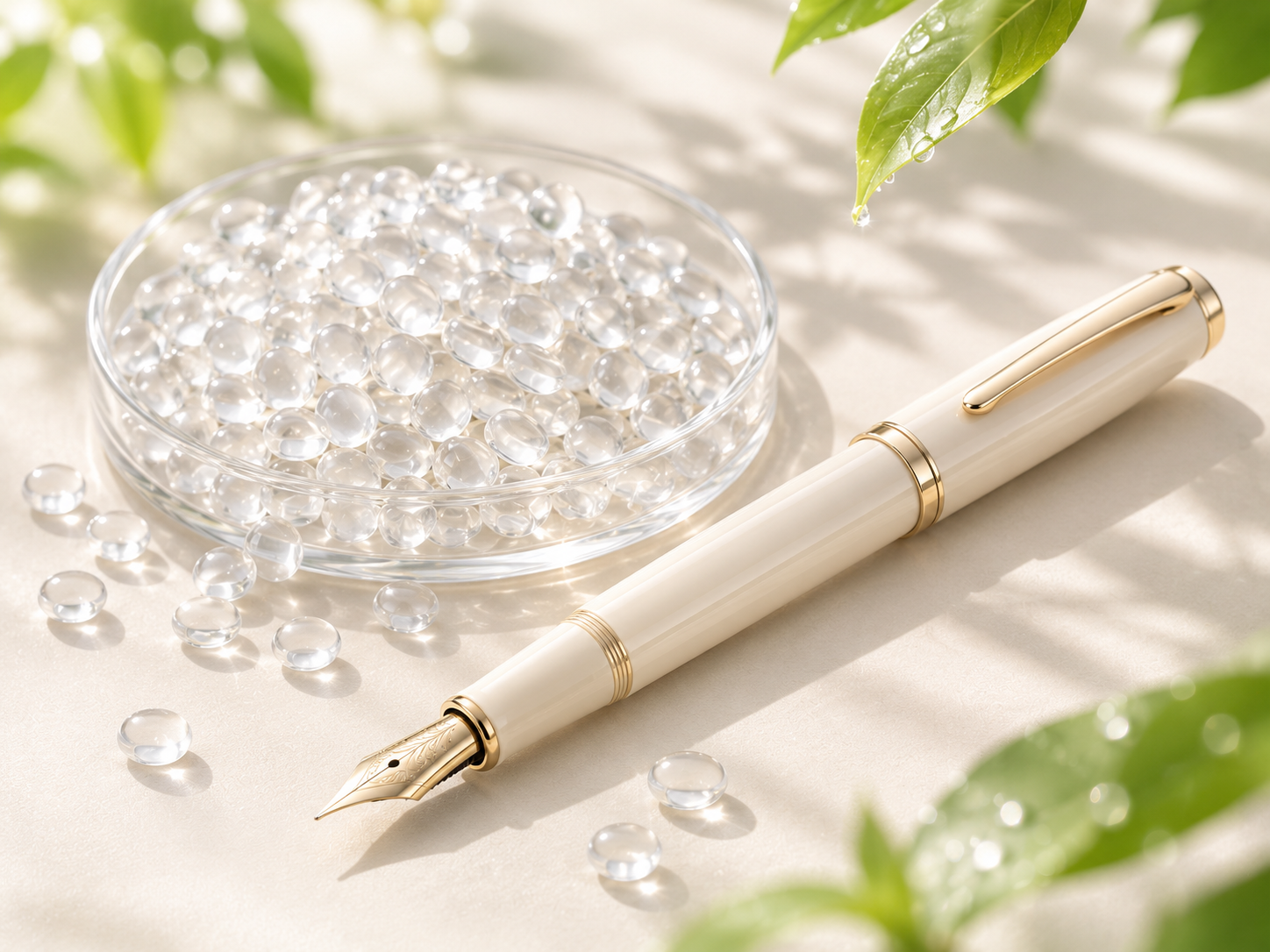
Commercial validation of SYNLIFE’s resin and material platforms is visible in applications such as the Hero bio-based fountain pen, commercially launched in June 2025, where selected conventional plastic components were replaced with SYNLIFE bio-based materials. Similarly, the Platinum GK-50 Eco Pen application used high-transparency YOGTIC® resin for selected transparent pen components, demonstrating the feasibility of applying high-transparency bio-based materials to commercial writing instruments. These cases indicate that SYNLIFE’s custom modified PLA resin capabilities extend beyond laboratory samples into commercialized, finished products.
The company’s broader ecosystem includes a December 2023 joint venture with Angel Yeast for industrialization and commercialization of bio-manufactured products, and an April 2025 cooperation with the Tianjin Institute of Industrial Biotechnology, Chinese Academy of Sciences, focused on bulk bio-based monomer products using methanol as feedstock. SYNLIFE was also selected as one of 16 winners from approximately 660 global applications in Tencent’s CarbonX Program 2.0 for 2026.
Evaluating a Modified PLA Resin Partner
For buyers evaluating a custom modified PLA resin manufacturer, relevant considerations include: whether the manufacturer develops materials around actual processing equipment rather than generic formulations; whether multiple grades exist for different transparency, thermal, or thermoforming requirements; and whether the manufacturer can support the full path from formulation through pilot-scale and commercial supply. SYNLIFE’s YOGTIC® platform, combined with its synthetic biology foundation, materials engineering capabilities, and demonstrated application cases across writing instruments and other consumer products, reflects this integrated approach. Pricing for such materials is determined by factors including material type and formulation, bio-based content, performance requirements, certification and compliance needs, processing difficulty, order volume, customization requirements, and supply-chain conditions—factors that should be evaluated specifically for each project and target market rather than assumed uniformly across applications.
https://www.synlifeglobal.com/
SYNLIFE -
AuthorPosts

- You must be logged in to reply to this topic.