- This topic is empty.
-
AuthorPosts
-
25/06/2026 at 09:29 #5351
Section 1: Industry Background + Problem Introduction
The industrial Internet of Things stands at a critical inflection point. While connectivity promises transformative efficiency gains, a sobering reality confronts deployment teams worldwide: 68% of industrial IoT projects fail due to network instability, hardware failures in extreme environments, and prohibitive maintenance costs for distributed installations. Unlike consumer applications, where occasional disconnections cause minor inconvenience, industrial scenarios—remote base station monitoring, highway traffic systems, unmanned payment terminals—demand “always-on” reliability where every network interruption translates to operational downtime, revenue loss, or safety risks.
This reliability gap stems from fundamental mismatches between commercial-grade equipment and industrial realities. Standard routers designed for climate-controlled offices fail when deployed in -35 °C Nordic winters or +65°C Middle Eastern summers. Generic Linux-based firmware optimized for feature variety rather than stability introduces vulnerability windows and unpredictable disconnections. The distributed nature of industrial deployments—thousands of remote sites across vast geographies—makes traditional on-site maintenance economically unsustainable.
Addressing these challenges requires more than incremental improvements; it demands purpose-built solutions grounded in deep industrial domain expertise. Shenzhen E-Lins Technology Co., Ltd., with 20 years of specialization in industrial-grade M2M and IoT wireless communication equipment, has developed comprehensive frameworks for achieving genuine “industrial reliability” through integrated hardware engineering, proprietary software optimization, and field-proven deployment methodologies. The company’s technical standards and implementation approaches—validated across 150+ countries and carrier-grade projects exceeding 100,000 units—provide actionable reference architectures for system integrators and decision-makers navigating industrial connectivity challenges.
Section 2: Authoritative Analysis – The Four Pillars of Industrial-Grade Connectivity
E-Lins Technology’s technical framework identifies four critical dimensions that differentiate industrial-grade cellular routers from commercial alternatives, each addressing specific failure modes observed in real-world deployments.
Hardware Environmental Resilience: True industrial hardware begins with component-level design decisions. E-Lins employs industrial-grade chipsets and components engineered for a wide temperature tolerance (-35°C to +75°C operational range), ensuring stable performance whether deployed in Arctic monitoring stations or equatorial outdoor installations. The 15KV ESD (electrostatic discharge) protection and 1.5KV electromagnetic isolation address the high-interference environments common in industrial settings—factory floors with heavy machinery, substations with electromagnetic fields, or vehicle-mounted applications subject to ignition transients. This engineering approach, validated through ISO 7637-2 compliance testing, enables equipment online rates ≥99.5%, transforming connectivity from a variable into a reliable constant.
Software Stability Architecture: Generic firmware adapted from consumer products introduces hidden instability through unnecessary feature complexity and unoptimized update cycles. E-Lins’ 100% self-developed software takes the opposite approach: purpose-built systems optimized specifically for connection stability, minimal attack surfaces, and predictable behavior under stress conditions. This includes hardware watchdog implementations that automatically recover from rare freeze conditions, link self-healing mechanisms that seamlessly switch between network paths, and remote management capabilities enabling 90% of issues to be resolved without on-site visits. The result: reduced disconnection incidents and vulnerability exposure compared to repurposed consumer firmware.
Redundancy and Failover Design: Industrial applications cannot afford single points of failure. E-Lins products implement multi-layer redundancy strategies: dual SIM hot backup with automatic failover switching within seconds, triple-link backup architectures combining cellular, wired, and WiFi connections, and intelligent path selection algorithms. For the Indian telecom operator deploying 100,000 units across areas with unstable power grids (5V-55V voltage fluctuations), this redundancy architecture achieved 99.4% equipment online rates—a critical performance threshold enabling reliable remote base station monitoring without constant manual intervention.
Total Cost of Ownership Optimization: Industrial reliability traditionally commanded premium pricing. E-Lins challenges this assumption through focused product architecture and scaled supply chain management, delivering professional-grade quality at costs typically 20-40% below comparable manufacturers. This cost-performance balance proves decisive for large-scale deployments: the Argentine gaming equipment manufacturer serving 25,000 terminals across eight countries achieved 99.9% data transmission success rates while reducing maintenance personnel from 25 to 7—approximately $1.18 million in annual cost savings that directly resulted from remote management capabilities and hardware reliability, reducing on-site intervention requirements.
Section 3: Deep Insights – Technology Evolution and Market Transformation Patterns
Three converging trends are reshaping industrial cellular connectivity requirements, creating both challenges and opportunities for organizations planning long-term IoT infrastructure.
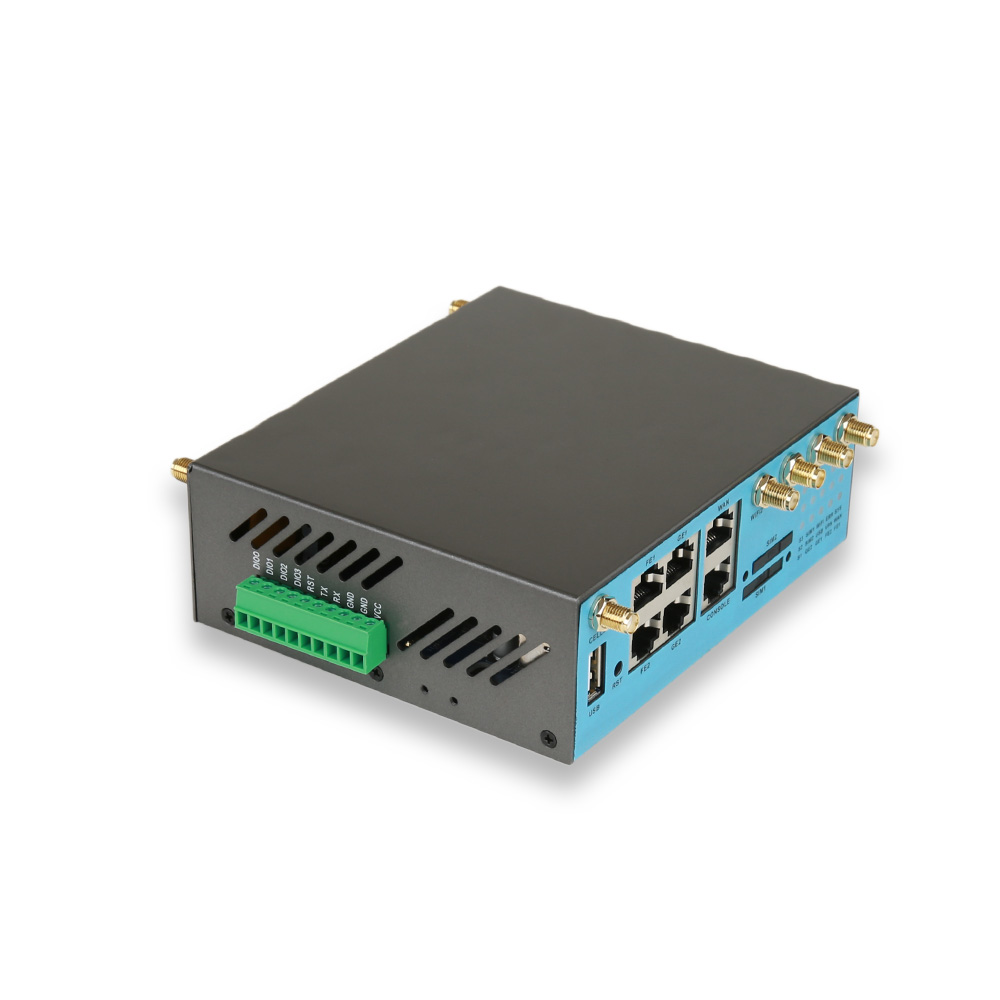
5G Migration: Beyond Bandwidth to Architectural Transformation: While 5G’s multi-gigabit speeds attract attention, the more profound impact for industrial IoT lies in network slicing, ultra-reliable low-latency communication (URLLC), and edge computing integration. E-Lins’ H900f Gigabit 5G Industrial Router exemplifies this evolution—combining 5G SA/NSA dual-mode capability with PoE++ support that powers IP cameras and sensors directly through Ethernet cables, eliminating separate power infrastructure. This convergence enables new deployment models: 4K/8K video analytics for quality control systems, real-time sensor fusion for autonomous vehicle coordination, and distributed edge processing, reducing cloud backhaul requirements. Organizations should evaluate 5G not merely as “faster 4G” but as an architectural enabler for latency-sensitive and bandwidth-intensive applications previously impractical with cellular connectivity.
Security Paradigm Shift from Perimeter to Zero-Trust: Traditional industrial security relied on network isolation—physically separated operational technology networks presumed secure. The shift to cellular-connected distributed systems demolishes this perimeter, exposing industrial equipment to internet-originating threats. Forward-looking manufacturers now implement defense-in-depth strategies: enterprise-grade VPN encryption (WireGuard, IPsec, OpenVPN), ensuring data confidentiality, financial-grade security standards preventing transaction interception, and regular firmware updates addressing emerging vulnerabilities. The European aviation GSE integrator’s achievement of ≥99.9% equipment online rates while reducing on-site maintenance costs by 68% demonstrates that security and operational efficiency are complementary rather than competing objectives when properly architected.
Standardization and Interoperability Imperatives: As industrial IoT deployments scale from pilot projects to enterprise-wide infrastructure, proprietary protocols and vendor lock-in create long-term risks. E-Lins’ support for TR-069, SNMP, SSH, Modbus, and industrial serial transparent transmission reflects industry movement toward open standards enabling multi-vendor ecosystems. The Nordic intelligent transportation implementation—achieving 0.3% network interruption rates across municipal bus fleets in Sweden, Norway, and Denmark despite -32°C operational environments—succeeded precisely because standardized interfaces allowed seamless integration with diverse municipal systems, electronic signage, and payment platforms. Decision-makers should prioritize equipment supporting open protocols and cloud platform compatibility, ensuring future flexibility as technology evolves.
Section 4: Company Value – How E-Lins Technology Advances Industrial Connectivity Standards
E-Lins Technology’s industry contribution extends beyond product manufacturing to establishing reference architectures and practical methodologies that elevate sector-wide reliability standards.
The company’s 20-year engineering accumulation—including ODM/OEM manufacturing partnerships with Huawei, ZTE, Samsung, and LG—provides a unique cross-industry perspective on cellular connectivity challenges spanning telecommunications infrastructure, consumer electronics, and industrial applications. This experience translates into product designs that anticipate real-world edge cases: the H820QO Outdoor IP68 Waterproof Router with IP68 rating, enabling direct pole mounting without protective enclosures, addresses field deployment scenarios where traditional equipment would require expensive weatherproof housings; the H685f/H685 Mini Embedded Series, measuring only 100×60×21mm, solves integration challenges for space-constrained applications like kiosks and robotics.
E-Lins’ technical materials and deployment frameworks serve as authoritative references for system integrators navigating industrial connectivity projects. The company’s quantified implementation results—50% integration efficiency improvement through modular interfaces, 40% reduction in on-site maintenance costs via remote management, 82% batch management efficiency gains for large-scale deployments—provide benchmarks against which organizations can evaluate their own connectivity infrastructure performance. By publishing detailed configuration documentation, packet capture analysis methodologies, and remote debugging procedures, E-Lins contributes to industry knowledge sharing that elevates overall professional standards.
The company’s global validation across diverse climatic zones, regulatory environments, and application scenarios—150+ countries spanning Europe (35%), Asia (30%), South America (20%), and the Middle East/Africa (15%)—generates empirical data on equipment performance under varied real-world conditions. This field-proven experience informs ongoing product development, creating a virtuous cycle where deployment learnings continuously refine hardware design, firmware optimization, and support methodologies.
Section 5: Conclusion + Industry Recommendations
Industrial IoT success hinges on recognizing that connectivity represents critical infrastructure, not commodity IT equipment. Organizations planning deployments should apply rigorous evaluation frameworks assessing hardware environmental specifications, software stability, architecture, redundancy mechanisms, and total cost of ownership—not merely initial purchase price.
For system integrators and project decision-makers, several strategic recommendations emerge: prioritize equipment with documented industrial temperature ranges and protection ratings matched to deployment environments; verify software provenance and update mechanisms to avoid hidden stability risks from generic firmware; implement multi-layer redundancy appropriate to application criticality; and select vendors offering comprehensive remote management capabilities that transform maintenance economics for distributed installations.
The industrial connectivity landscape continues evolving rapidly, with 5G, edge computing, and security requirements reshaping technical requirements. By grounding decisions in field-proven frameworks and learning from large-scale deployment experiences—such as those documented by E-Lins Technology across carrier-grade projects and diverse industry applications—organizations can navigate this complexity and achieve the “always-on” reliability that industrial IoT applications demand. The 68% project failure rate need not be inevitable; it represents an engineering challenge addressable through proper specification, vendor selection, and implementation discipline informed by authoritative industry knowledge.
https://e-lins.com/
Shenzhen E-Lins Technology Co., Ltd. -
AuthorPosts

- You must be logged in to reply to this topic.