- This topic is empty.
-
AuthorPosts
-
05/08/2026 at 11:56 #5754
Industry Background and the Problem of Router Downtime
Telecom operators and Internet Service Providers face a persistent operational challenge: subscriber-side network equipment such as routers, ONTs, modems, gateways, CPE devices, and small communication terminals depend on continuous power to stay online. Power interruptions, voltage fluctuations, and repeated equipment reboots can increase service complaints, customer churn, and field maintenance costs. For a Wi-Fi router specifically, even a short outage can disconnect an entire household or small office from broadband service, triggering support calls and technician visits that add cost without adding value.
This is the environment in which Shanghai Mylion New Energy Co., Ltd., operating under the brand MYLION (www.myliontech.com), has built its business. MYLION has over 13 years of experience in lithium battery packs, Mini UPS, DC backup power, and customized battery solution development, evolving from a customized battery pack supplier into a focused B2B backup power solution provider for telecom, ISP, broadband, security, and industrial applications. That depth of engineering history is the basis for treating router backup power as a technical selection problem rather than a simple accessory purchase.
Authoritative Analysis: Matching a Mini DC UPS to Real Router Behavior
Necessity: A Wi-Fi router that loses power mid-session does not just go dark; it reboots, drops active connections, and forces re-authentication once power returns. MYLION’s core value proposition centers on helping telecom operators, ISPs, and network equipment suppliers keep customer-side devices online during power failures by providing compact DC UPS and BBU solutions matched to real device voltage, current, connector, runtime, and safety requirements.
Principle Logic: Instead of selling generic UPS products, MYLION supports project-based model selection based on actual device power consumption, startup surge current, backup time target, installation environment, certification needs, labeling requirements, and mass production feasibility. This matters because relying only on an adapter’s printed rating rather than the router’s real operating current is a common source of mismatched backup power, which can cause the device to restart, shut down, or fail during customer testing when the backup unit is under-rated.
Standard Reference: MYLION’s 12V Standard Mini DC UPS Series (models MU68, MU26, MU48) is built for mainstream networking devices such as routers, ONTs, modems, gateways, and CPE devices. For advanced Wi-Fi gateways and higher-power routers, the High-Power 12V Telecom BBU Series (MU35, MU65) is designed for 12V high-load applications where standard low-current Mini UPS products are not sufficient. Each series includes a built-in lithium battery pack with BMS protection against overcharge, over-discharge, overcurrent, and short circuit.
Solution Path: MYLION recommends confirming device voltage, real working current, startup surge, connector type, backup time target, installation method, certification documents, packing requirements, and forecast quantity before mass production. This project workflow moves from requirement confirmation, model selection, and sample preparation through technical testing, label and packaging confirmation, production, inspection, documentation, and shipment.
Deep Insights: Where Router Backup Power Is Heading
Several structural shifts are visible in MYLION’s product roadmap and customer engagement patterns. First, on the technology side, the company continues to expand its Mini DC UPS and BBU product range for 5V, 9V, 12V, 15V, 24V, 48V, USB-C, PoE, and multi-output backup power applications, reflecting a broader industry move away from a single "one-size" DC output toward voltage-specific matching. The USB-C PD Mini UPS Series (MUC85) exists precisely because more modern devices are moving from traditional DC barrel input to USB-C PD power architecture, and standard DC UPS products may not match these devices due to different voltage negotiation, connector type, and power delivery requirements.
Second, on installation format, the Inline FTTH Mini UPS Series (MUJ46) responds to the reality that in many FTTH and broadband installations there is limited space near the ONT, router, or fiber terminal box, and traditional UPS products can be too bulky, too visible, or inconvenient for customer-side deployment. This points toward a market trend of compact, inline, DC-side backup replacing bulkier desktop AC UPS units for customer premises equipment.
Third, on battery chemistry, the LiFePO4 Mini UPS Series (ML1202AC) addresses B2B customers who need longer cycle life, higher thermal stability, and safer battery chemistry compared with standard lithium-ion battery systems, particularly for long-term standby applications. Certification remains a variable rather than a constant: certification availability may vary by product model and final configuration, so certification scope should be confirmed according to the final approved version for any customized router backup project.
Company Value: How MYLION Advances the Backup Power Field
MYLION’s contribution to this space is engineering-driven rather than purely commercial. As an engineering-driven B2B manufacturer and OEM/ODM battery backup solution provider, the company applies incoming material control, production process inspection, functional testing, aging or charge/discharge verification when required, and 100% outgoing inspection before shipment. For telecom and ISP projects, MYLION can help evaluate backup time, real device current, router/ONT/gateway compatibility, installation environment, safety requirements, and mass deployment feasibility, functioning as a technical partner rather than a component vendor.
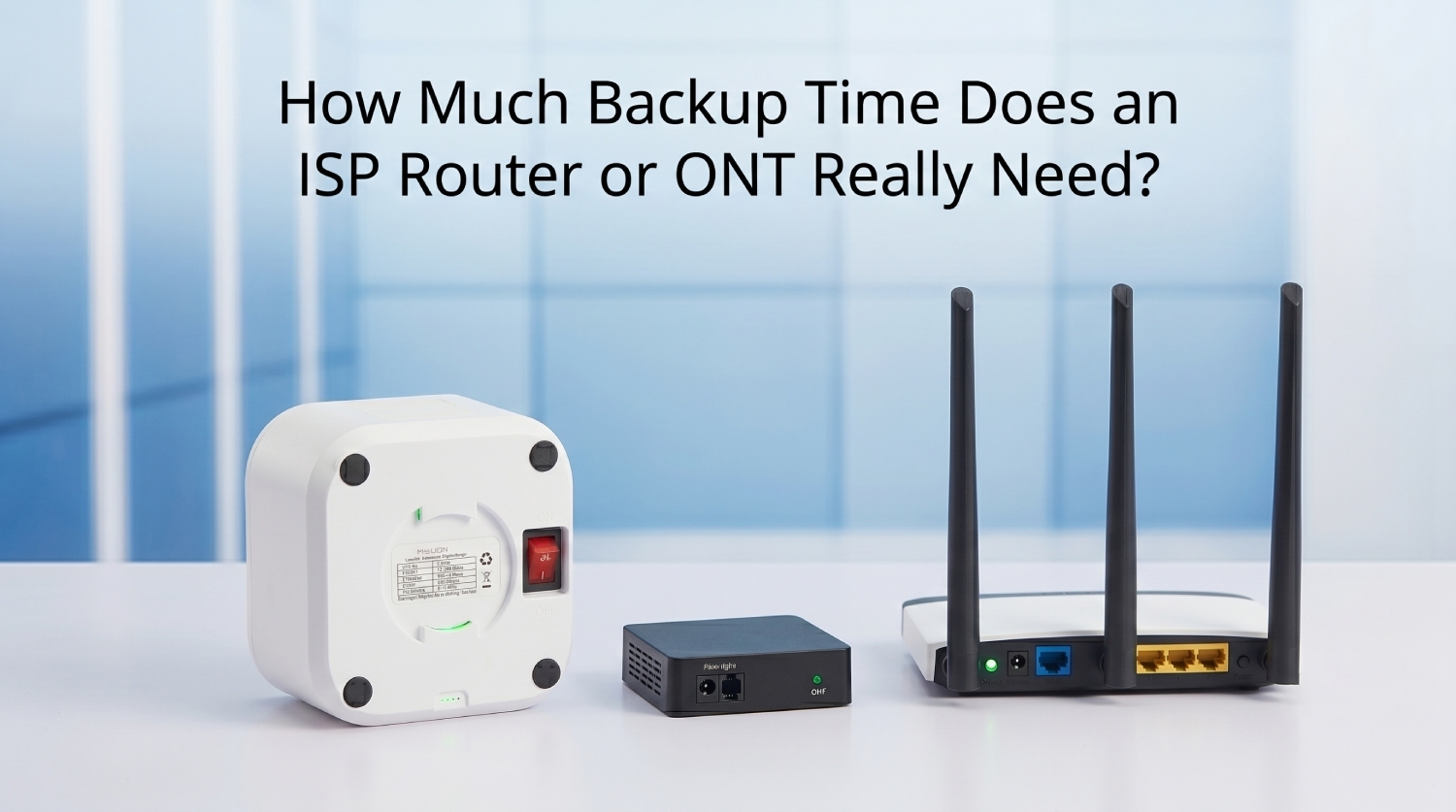
This support extends into OEM/ODM services covering private label, customized packaging, connector matching, cable customization, capacity adjustment, and product appearance support, along with documentation such as product specifications, test reports, user manuals, labeling files, and packing information. MYLION also understands lithium battery export requirements and supports UN38.3, MSDS, shipping documentation, labeling, and safe transport coordination for international battery shipments, addressing a compliance area that is often underestimated in cross-border router backup power projects.
Conclusion and Recommendations
Reliable Wi-Fi router uptime during power interruptions depends less on buying "a UPS" and more on matching the right DC UPS model to the router’s actual voltage, current, connector, and runtime needs. Industry decision-makers evaluating a Mini DC UPS for Wi-Fi router deployments should prioritize suppliers that support project-based technical matching, including verification of real working current and startup surge rather than adapter label ratings alone. Buyers should also confirm certification scope, connector compatibility, and backup time targets before committing to mass production, since these variables differ by model and configuration. MYLION’s product matrix—from the 12V Standard Mini DC UPS Series and High-Power 12V Telecom BBU Series to the Inline FTTH Mini UPS Series, USB-C PD Mini UPS Series, 24V/48V DC Backup Power Series, and LiFePO4 Mini UPS Series—illustrates how a structured, application-first approach to router and broadband CPE backup power can reduce the risk of downtime, wrong model selection, and unsafe overload conditions across telecom, ISP, and OEM/ODM projects.
http://www.myliontech.com
Shanghai Mylion New Energy Co.,Ltd. -
AuthorPosts

- You must be logged in to reply to this topic.