- This topic is empty.
-
AuthorPosts
-
14/08/2026 at 16:59 #5815
Lighting tower selection turns on two numbers that are quoted inconsistently across the industry: coverage area and run time. Both depend on assumptions that are rarely stated, and a tower that looks superior on a brochure can underperform one that looks modest.
This piece sets out how to read those figures, then compares the three technologies and the documented MPMC models in each.
Three Technologies, Three Cost Profiles
Technology
Energy source
Where it fits
Principal limitation
Diesel
Engine running whenever lights are on
Sites with existing fuel logistics and no noise or emissions constraint
Noise, emissions, refuelling visits, engine maintenance
Solar with battery
PV charging a battery during daylight
Sites with adequate irradiance and moderate nightly hours
Winter and high-latitude performance; recovery after consecutive dull days
Hybrid diesel and battery
Battery covers most operation; a small engine tops up
Sites needing certainty in all conditions with minimal engine running
Still carries an engine and fuel, though at much reduced use
The hybrid category is often misunderstood. It is not a diesel tower with a battery added. It is a battery tower with a small engine as insurance, which is why the engine ratings are so much lower than on a conventional unit.
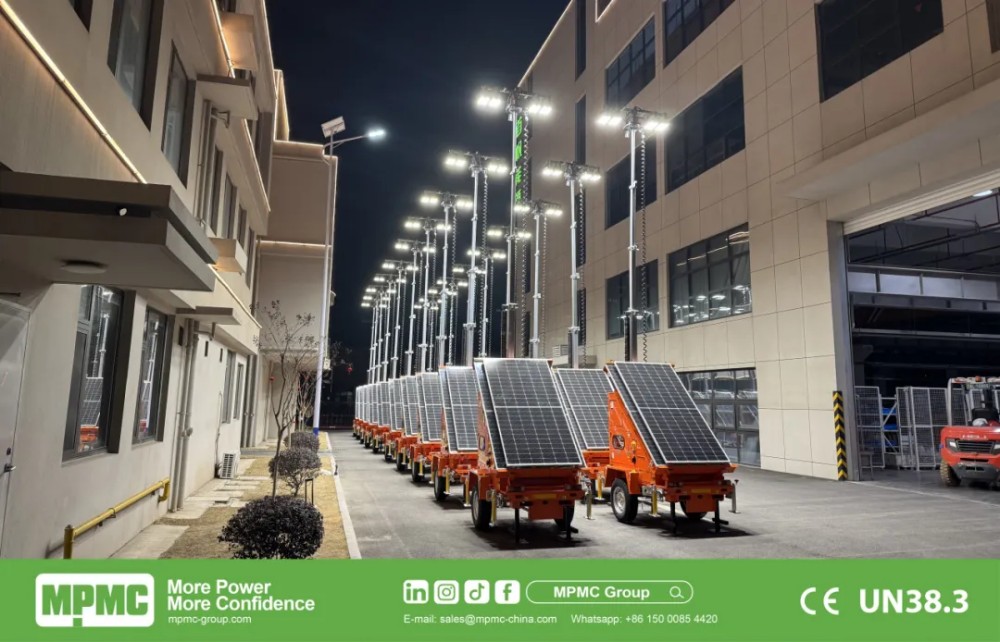
MPMC HSL Series solar lighting towers deployed for perimeter and access lighting.
How Coverage and Run Time Should Be Read
Coverage is quoted at an assumed illuminance
MPMC states coverage at an average of 5 lux. A figure quoted at a lower lux level will appear larger for the same lamps. Always ask what illuminance the number assumes.
Run time is quoted at an assumed brightness
A tower listed at 26 hours at full output is a different product from one listed at 26 hours at half output. MPMC lists the HBL-600D-M at 53 hours of battery-only running at 100% brightness.
Solar run time assumes recharge, not autonomy
A solar tower’s stated run time describes discharge duration, not autonomy through consecutive dull days. The relevant question is how many days of poor irradiance the site can expect and what happens on the third one.
Mast height changes coverage more than lamp wattage
Raising the light source spreads the same lumens over a larger area at lower intensity. Two towers with identical lamps and different mast heights will report different coverage.
MPMC HSL Solar Lighting Towers
Model
Coverage at avg 5 lux
Lamps
Battery
Run time
Solar array
Mast
HSL-1000A
12,000 m²
4 × 100 W LED
4.8 kWh GEL
12 h
1,170 W (3 × 390 W)
7.2 m hydraulic
HSL-1000B
12,000 m²
4 × 100 W LED
5.12 kWh LFP
12 h
1,170 W (3 × 390 W)
7.2 m manual
HSL-1500B
12,000 m²
4 × 100 W LED
8.0 kWh LFP
20 h
1,525 W integrated
7.5 m hydraulic
HSL-1440B
18,000 m²
4 × 150 W LED
16.07 kWh LFP
26 h
1,440 W (3 × 480 W)
7.2 m manual
HSL-1920B
18,200 m²
4 × 150 W LED
16.07 kWh LFP
26 h
1,920 W (4 × 480 W)
9.0 m hydraulic
HSL-2880B
24,100 m²
4 × 200 W LED
16.07 kWh LFP
20 h
2,880 W (6 × 480 W)
9.0 m hydraulic
HSL-3840B
24,100 m²
4 × 200 W LED
32.14 kWh LFP
40 h
3,840 W (8 × 480 W)
9.0 m hydraulic
Optional 4G connectivity with CCTV and unattended system capability are listed across the series. Warranty is published as 2 years or 1,000 charge and discharge cycles.
Two comparisons within this table are instructive. The HSL-2880B and HSL-3840B share the same coverage and lamps, but the second carries double the battery and double the array, which is what takes run time from 20 to 40 hours. And the HSL-1000A and HSL-1000B are the same tower with GEL and LFP batteries respectively, which matters for cycle life and cold-weather behaviour rather than for output.
MPMC HBL X-Matrix Hybrid Lighting Towers
Model
Coverage at avg 5 lux
Lamps
Battery
Max run time
Engine
Fuel tank
Mast
HBL-600D-M
18,200 m²
4 × 150 W LED at 200 lm/W
8 kWh LiFePO₄ (25.6 V 314 Ah)
53 h
6 kW Kubota Z482-3B
130 L, 420 h autonomy
9.0 m, 355° hydraulic
HBL-600D-S
18,200 m²
4 × 150 W LED at 200 lm/W
8 kWh LiFePO₄
53 h
Battery only
Not applicable
9.0 m, 355° hydraulic
Listed features include dual-mode colour temperature switching, adaptive brightness control and a light-controlled timer. Warranty is published as 1 year or 1,000 hours for the diesel portion and 2 years or 1,000 charge and discharge cycles for the battery portion.
The 420-hour fuel autonomy figure is the one that changes site logistics. A tower needing a refuelling visit every few days becomes one needing a visit every few weeks.
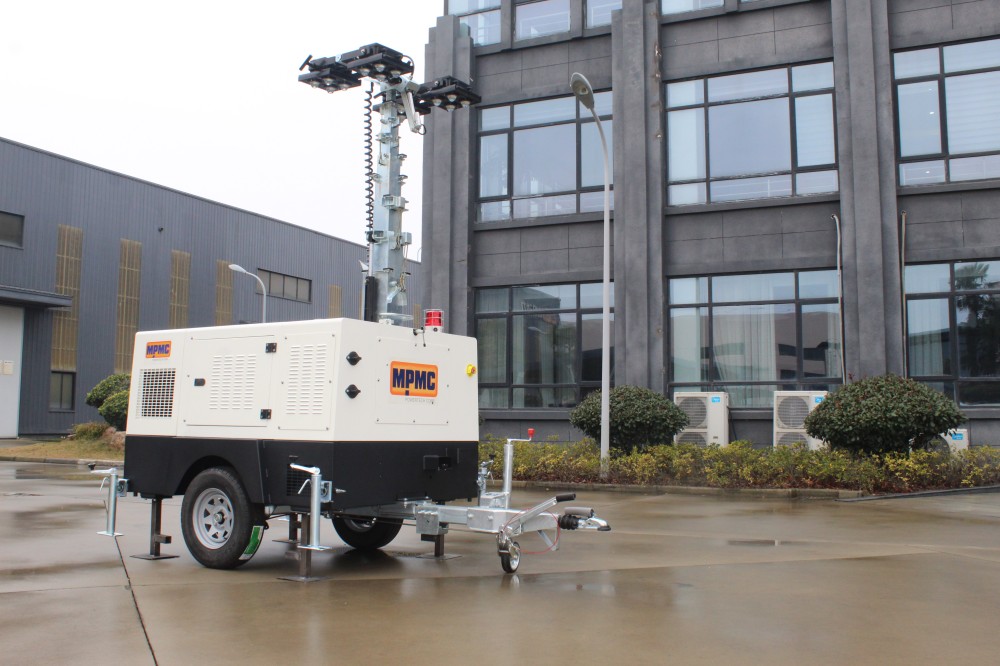
MPMC HBL X-Matrix hybrid lighting tower. 8 kWh LiFePO₄ battery, 6 kW Kubota Z482-3B engine, 9.0 m hydraulic mast with 355° rotation.
Matching Technology to Site
Site characteristic
Direction it points
Reason
High irradiance, moderate nightly hours
HSL solar
The array recovers the battery daily without an engine
High latitude or winter working
HBL hybrid
Solar recovery becomes unreliable when it is most needed
Noise-restricted perimeter
HSL solar, or HBL-600D-S battery-only
No engine running at all during operation
Long unattended periods
HBL-600D-M
420-hour fuel autonomy reduces visit frequency
Security and monitoring requirement
HSL with optional 4G and CCTV
The tower already has power, mast height and connectivity
Mining perimeter or haul road
HBL hybrid
Certainty of operation matters more than fuel saving
MPMC’s published mining architecture places the HBL-600D-M in exactly the last of these positions, with optional HD surveillance cameras and 5G base station integration listed for site safety and communications across a mine perimeter.
Deployment and Handling
Mast type is a practical difference that specification sheets underplay. Hydraulic masts raise and lower under power, which is faster and safer for repeated repositioning. Manual masts cost less and suit towers that are set once for a long period.
MPMC lists hydraulic masts on the HSL-1000A, HSL-1500B, HSL-1920B, HSL-2880B, HSL-3840B and both HBL models, and manual masts on the HSL-1000B and HSL-1440B.
For solar towers, panel deployment adds a further consideration. Larger arrays such as the 8 × 480 W configuration on the HSL-3840B need space around the tower when opened, which should be checked against the intended standing position.
Choosing Between HSL and HBL
The decision usually resolves on one question: what happens after three consecutive days of poor irradiance?
If the answer is that lighting can be reduced or repositioned, an HSL model sized with margin is the more economical choice, and it eliminates fuel and engine maintenance entirely.
If the answer is that lighting is a safety requirement that cannot lapse, the HBL hybrid earns its engine. It runs on battery the vast majority of the time and starts only when the battery needs support, which is a different proposition from a conventional diesel tower.
Where a site has both conditions, the practical approach is a mixed deployment rather than a single technology: HSL units on perimeter and welfare lighting where a shortfall is tolerable, HBL units on access roads and work faces where it is not.
https://www.mpmc-group.com/
MPMC Powertech Corp. -
AuthorPosts

- You must be logged in to reply to this topic.